
The rental desk checks the spreadsheet. Someone calls the yard. Another person opens a different system or scrolls through messages.
A few minutes later, the answer comes back, sometimes with confidence, sometimes with a caveat: “Let me double-check and get back to you.”
By the time the customer receives a firm reply, three people and two or three tools have already been involved. This is not an isolated inconvenience. It is a daily symptom of something deeper.
The Data Behind the Scramble
Industry research shows how widespread the issue remains. According to a 2025 State of Tech in the Equipment Rental Industry report, only 16% of rental operators have achieved fully integrated systems. The majority, 67%, operate with partially integrated systems that still require manual data transfer. Roughly half continue to rely on manual methods alongside their digital tools.
Most companies manage three to four disconnected systems. Seven out of ten report losing valuable time to inefficient processes. The practical result is what operators experience every day: availability answers depend on who you ask and when.
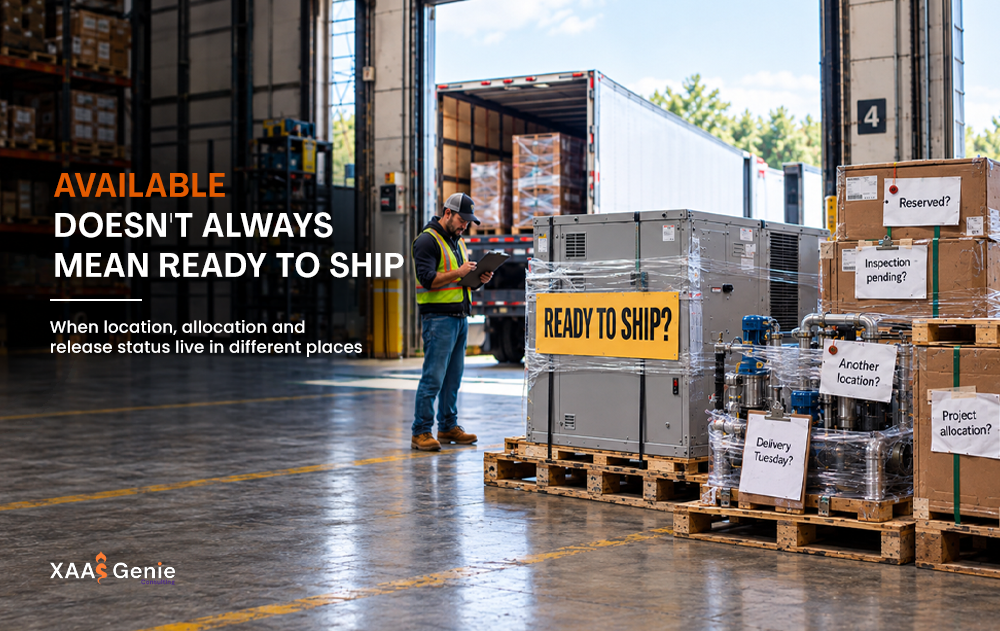
When location data, maintenance status, reservation records, and financial information live in separate places, the rental desk, the yard, and the spreadsheet rarely agree in real time. A unit that appears free in one system may already be committed, in maintenance, or sitting at another location.
What the Friction Actually Costs
The daily three-phone-call routine creates measurable downstream effects:
- Slower response times reduce the chance of winning the booking. Customers who need a quick, confident answer often move on.
- Lower utilization becomes harder to avoid. Industry benchmarks put healthy time utilization in the 65-75% range for most equipment categories. When status is unclear, assets sit idle longer than they should while teams reconcile information.
- Revenue leakage compounds. More than 53% of rental businesses report losing revenue due to equipment downtime, and 44.7% identify missed billing as a major leak. Both problems are more likely when availability and status data are fragmented.
- Internal capacity is consumed. Staff who should be booking jobs, preparing equipment, or serving customers spend part of every day acting as the human integration layer between systems.
Even modest improvements matter. On a fleet valued at $1 million, raising utilization by just 10 percentage points can translate into six figures of additional annual revenue. Yet that improvement is difficult to capture when the basic question “Is this available?” still requires multiple checks.
Why the Problem Persists as Companies Grow
In the early stages of an equipment business, spreadsheets and verbal updates often work adequately. Volume is limited, the team is small, and everyone maintains a reasonable mental model of the yard.
As project volume increases, additional locations come online, and customer-owned assets mix with company inventory, that shared understanding breaks down. Physical movement outpaces digital records. Returns arrive at irregular times. Maintenance status changes without immediate updates. The lag between what is actually happening on the ground and what the systems show widens.
Training staff to update spreadsheets faster does not close the lag. Adding another shared file does not create a single operational view. Hiring more coordinators simply adds more people to the same fragmented information flow.
As long as location, status, project association, and availability live in separate places, the scramble continues and the cost scales with the business.
The Real Question Behind Availability
When a customer asks whether equipment is available, they are really asking several related questions at once:
- Where is it right now?
- What is its current status?
- Is it reserved, in maintenance, or free to commit?
- When can it realistically be released or delivered?
If answering those questions still requires human coordination across desks and systems, the operation has already outgrown its visibility architecture.
The businesses that handle growth more smoothly are the ones that can answer “Is this available?” from a single, reliable source, without the three phone calls. Until that happens, the simple question will keep costing more time, more coordination, and more missed opportunity than it should.