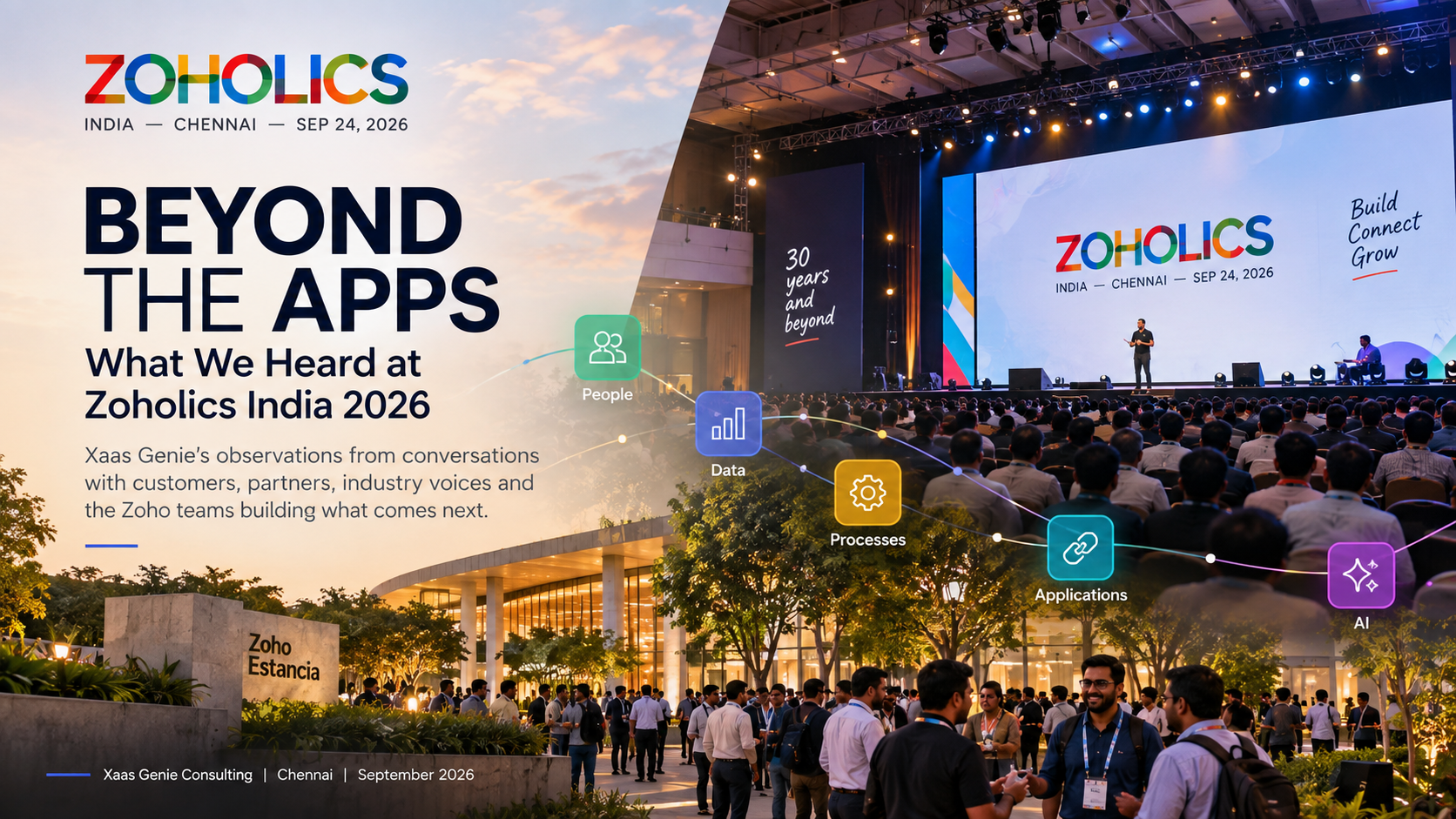

Xaas Genie’s observations from conversations with customers, partners, industry voices and the Zoho teams building what comes next.
We went to Zoholics India 2026 to listen. We came back with a few questions of our own.
This year’s event felt different—not because there were fewer product announcements, but because so many of the conversations seemed to point in the same direction. At Zoho’s Estancia Campus in Chennai, we spoke with customers, prospects, partners, industry voices, analysts, Zoho leadership, product and offering teams, sales teams and regional alliance teams.
The individual conversations were different. The underlying concern was often the same: businesses don’t really want another piece of software to manage. They want the systems they already have to work better together.
Less fragmentation. Less manual work. Better context. Faster time-to-value. And, increasingly, a very practical question about AI: can it actually do something useful with the data a business already has?
That, for us, was the most interesting shift at Zoholics—from buying applications to connecting the business.
What We Heard from the Market
The conversations were refreshingly practical. There was plenty of interest in AI, but very little appetite for AI simply because it is the latest thing. The questions were much closer to the day-to-day reality of running a business.
- Where can we get people out of spreadsheets and manual reporting?
- Why does the same customer or transaction still have to be moved between systems?
- How do we reduce the amount of work that depends on one person knowing the workaround?
- How do we scale a process without scaling the headcount behind it?
- How do we turn a new technology capability into something the business can actually measure?
The other question sitting underneath all of this was adoption. As AI and agentic capabilities become more capable, businesses will need to decide not only what they can automate, but what their people will actually use—and trust.
For us, that is an important distinction. The value of technology is not really in the number of features switched on. It is in what changes in the way the business operates.
The Partner Conversation Is Changing
We heard a similar shift in conversations with partners. The old question was often: “Can you implement Zoho?” The more interesting question now is: “Can you solve the business problem?”
That takes a different kind of conversation. It starts with the industry and the process, then moves through data, integration and automation, and only then gets to AI and adoption.
Industry → Process → Data → Integration → Automation → AI → Adoption
The technology sits underneath all of this. The outcome sits above it.
That is why we think the partner’s role is changing. It is less about configuring an application in isolation and more about understanding how the business works, connecting the right systems, redesigning the process where necessary, and making sure people actually use what has been built.
In other words, the value increasingly sits between the applications and the business.
What Zoho Is Signaling
The announcements and demonstrations at Zoholics reinforced that direction. Zoho is pushing toward a platform that is more connected, more intelligent and more deeply aware of the industries it serves.
Zia Chat was one of the clearest examples. Zoho presented it as a conversational interface across Zoho applications, with the ability to connect to external systems through MCP integrations. The idea is straightforward: instead of moving between applications to find context and then take an action, users can ask, understand, analyse and act through one interface—within the permissions already defined for them.
Zoho also highlighted vertical SaaS initiatives across seven industries—retail, automotive, BFSI, healthcare, education, real estate and restaurants. Alongside these were developments in Zia Agents, Agent Studio, AgentInbox, Zoho One, Analytics, developer tools and connected suites such as People Plus.
Taken together, these are more than a collection of new features. They point toward a model in which context, reasoning and action increasingly sit across the business rather than inside one application.
From AI Assistance to Action
One of the biggest shifts we noticed was the move from AI that helps with a task to AI that can increasingly take part in the task.
The discussion around Zia is moving toward agents that can handle multi-step work—lead scoring, follow-ups, support triage, reporting and workflow triggers—within defined permissions and controls.
That creates an important difference. An AI feature can help someone do today’s job a little faster. An AI-enabled operating model can change how the job itself gets done.
But the second requires foundations. The data has to be reliable. The processes have to be clear. The integrations have to work. Permissions need to be thought through. And the people using the system need to understand what it is doing and why.
The Interface Is Changing Too
There was another theme we kept coming back to: people spend an extraordinary amount of time navigating software.
They open one application, search for something, move to another system, copy information across, send an email, check a spreadsheet and then go back to the first system. The data may exist, but the context is scattered.
A conversational layer changes that experience. Instead of asking employees to remember where information lives, the interaction can start with what they need to know or what they need to get done.
The applications don’t necessarily disappear. But they can become much less visible in the day-to-day experience of running the business.
Vertical Depth Meets a Connected Platform
Zoho’s move into vertical SaaS adds another interesting dimension. A broad platform can cover a lot of ground, but some industries have workflows, terminology, controls and compliance requirements that generic configuration cannot fully address.
The seven vertical initiatives suggest that Zoho is increasingly building some of that industry context into the product itself rather than leaving everything to customisation later.
For businesses, the question becomes more nuanced: what should come from the standard platform, what needs industry-specific capability, and where does custom process automation create the real difference?
The Real Challenge: Adoption
If we had to reduce our takeaway from Chennai to one word, it would be adoption.
A business can have CRM, Finance, HR, Projects, Analytics, Creator and AI—and still run important parts of the operation through Excel, WhatsApp, email and a handful of workarounds that everyone knows but nobody officially owns.
So the question isn’t simply, “What can Zoho do?”
A better question is: “What will people actually adopt—and what business problem will it remove?”
That is where implementation, process design, integration and change management become much more than delivery disciplines. They determine whether the technology becomes part of the operating model or remains another layer on top of it.
What This Means for Xaas Genie
Zoholics reinforced something we have been seeing in our own work: many businesses don’t need more applications. They need to get more value from the applications they already have.
For us, that means starting with the operational problem, not the product catalogue. It means looking at where work is still manual, where data gets stuck, where systems don’t talk to each other and where people have created workarounds simply to get the job done.
It also means preparing the foundations for what comes next—stronger data, better processes, sensible integrations and an adoption plan—before asking AI or agents to take on more responsibility.
The goal is not to make the technology more visible. Ideally, it becomes less visible because the business simply works better.
Beyond the Apps
This is probably our biggest takeaway from Chennai.
The next Zoho opportunity isn’t necessarily another application. It is the connected business.
Applications connect. Data connects. Processes connect. AI connects context. And people actually use the system.
That changes the role of the partner too. From implementer to business transformation partner.
We came to Chennai to listen. We came back thinking differently. And we suspect this conversation is only getting started.
Want to Talk Through Your Zoho Setup?
If your business already runs on Zoho but still relies heavily on spreadsheets, manual handoffs, disconnected applications or workarounds, we’d be happy to have a practical conversation about it.
You don’t need to prepare a formal RFP or know which Zoho product you need. Bring us the business problem. A Xaas Genie consultant can look at the process with you, identify where the friction sits, and discuss what could realistically be improved through integration, automation, process redesign or AI.
→ Request a conversation with a Xaas Genie expert
Tell us the process or business challenge you are trying to fix, and we’ll take it from there.

Ready to Transform
Your Business.
Identify process gaps, automation opportunities and technology bottlenecks affecting your business growth.