
The reality of most mid-market manufacturing plants is that they don’t run on software; they run on adrenaline and the physical presence of three key people: your plant manager, production supervisor, and operations head.
If one of them calls in sick, takes a weekend off, or gets pulled into an all-day client meeting, the factory floor slows down. Approvals grind to a halt, reporting stalls, inventory discrepancies pile up, and critical escalations hang in limbo. The reliance on verbal pass-offs and physical clipboards means operational velocity is directly capped by human availability.
When leadership asks fundamental questions, the answers shouldn’t require tracking down a supervisor:
- What is today’s actual production output across all lines?
- Which machine is down on Floor 2, and what is the estimated resolution time?
- Which customer order is delayed, and why?
- What is our exact material rejection rate this week, and which vendor batch caused it?
Relying on human gatekeepers for routine oversight creates a systemic bottleneck. To scale your manufacturing operation without a proportional spike in management overhead, you don’t need more supervisors walking the floor. You need an architecture that monitors, flags, and acts autonomously.
Shifting from Human Oversight to Systemic Vigilance
When we talk about an automated architecture, we aren’t talking about replacing the human intelligence on your shop floor. We are talking about liberating it. Traditional plant management relies heavily on physical presence, a manager walking the line, checking paper logs, and catching errors purely by sight or post-facto review.
True operational resilience happens when your processes are governed by a system that doesn’t need to rest, eat, or step away from the floor. This exact shift in perspective inspired our core architecture. The framework itself was organically defined by one of our clients, Rachith Goel, Director at Radiant Anodisers. When we deployed this automated system across his manufacturing facility, he gave the framework a unique, practical nickname: his “Sleeping Manager.”
He described it as a digital backbone that is “always there, taking care of things, without being in your face.” For the team at Radiant Anodisers, this framework is so deeply woven into their daily workflows that running production for even a single day without it would cause severe logistical setbacks. It acts as a vigilant, 24/7 digital supervisor that quietly enforces your operational protocols, freeing your leadership team from playing telephone with status updates so they can focus on long-term capacity planning and production optimization.
The Architectural Core: The XAAS Genie Autonomous Operations Framework™
To transition a plant from reactive firefighting to self-governance, operational data must move seamlessly between human operators, physical machines, and business logic. The XAAS Genie Autonomous Operations Framework™ creates an interconnected engine that coordinates every phase of manufacturing without requiring manual intervention at each step.
Instead of disparate departments operating in isolation, where sales orders live in spreadsheets, inventory balances are tracked on whiteboards, and machine issues are passed around verbally, this core framework establishes a unified digital protocol. Every production milestone triggers downstream actions instantly. Orders automatically generate work instructions, material movements calculate real-time inventory adjustments, and quality deviations route immediate notifications to responsible engineers. By embedding governance into the operational flow itself, the framework allows factory managers to shift from constantly pushing tasks forward to simply monitoring an autonomous, self-correcting system.
The Stack: Building an Autonomous Factory on Zoho Creator
Many enterprise manufacturing systems (ERPs) are rigid, expensive, and notoriously difficult for shop-floor workers to use. They require complex data entry, lack field-level customization, and often demand multi-year implementation cycles. That is why we architect the framework using Zoho Creator for manufacturing.
As a low-code workflows, Zoho Creator allows us to build a highly tailored, agile Zoho Creator manufacturing ERP that fits your exact processes, whether you handle custom job-work, high-volume assembly, or complex surface treatments, without the bloated code or multi-year rollout timelines of traditional legacy software.
When combined into a unified operational engine, we map out a multi-layered architecture that completely digitizes your production cycle:
1. Data Layer (The Single Source of Truth): Before a system can automate, it needs flawless data structures. We design custom forms and unified relational databases to manage:
- Master Data: Customer profiles, Vendor registries, Bills of Materials (BOM), active Machinery logs, and Version-Controlled Engineering Drawings.
- Transactional Forms: Purchase Orders (PO), Material Inward Receipts (MIR), Job Work Challans, and Multi-stage Work Orders.
2. Process Layer (Manufacturing Workflow Automation): This is where the autonomous engine comes alive. Using Zoho’s native Deluge scripting language, we build deep manufacturing workflow automation that eliminates manual data handoffs:
- Order-to-Cash Automation: As soon as a Sales Order is approved, the system automatically generates a corresponding Job Order/Challan, allocates inventory, and routes it directly to the designated production line.
- Dynamic Status Triggers: The moment an operator completes an operational phase (e.g., Pre-Production → Anodizing/Assembly → Quality Control), the system automatically updates the material location, recalculates job progress, and assigns the task to the next workstation terminal.
- Auto-Consumption: Raw materials are systematically deducted from Work-in-Progress (WIP) inventory based on real-time production logs and BOM calculations, keeping stock counts precise down to the batch.
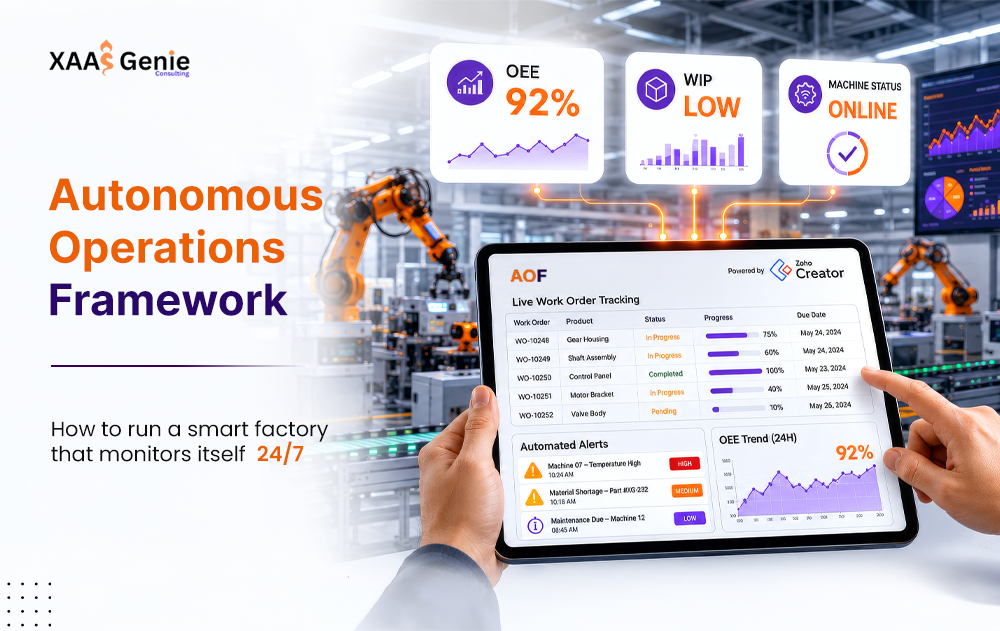
3. Intelligence Layer (Real-Time Dashboards & Alerts): If a critical machine overheats or an order misses its gate deadline, you shouldn’t have to wait for the evening shift report to find out.
- Real-Time Production Dashboard: Displays live line yields, work order progression, operator efficiencies, and dynamic batch statuses on factory display panels.
- Machine Status & Performance: Instantly flags downtime incidents and tracks drops in Overall Equipment Effectiveness (OEE) metrics across all floors.
- Automated Exception Escalations: If a yield variance occurs or an inspection triggers a quality rejection, the framework bypasses traditional communication delays to send instant alerts via SMS, Email, or WhatsApp directly to the floor engineer or supervisor who can resolve it.
Comparing Operational Models: Manual vs. Autonomous Operations
| Operational Dimension | Traditional Manual Operations | XAAS Genie Autonomous Framework |
| Shift Handoffs | Manual logbooks, verbal updates, high error rate | Instant digital sync, automated task queue assignments |
| Inventory Tracking | Periodic physical counts, frequent WIP discrepancies | Real-time automated consumption based on BOM logic |
| Quality Control | End-of-day defect reporting, delayed root-cause analysis | Immediate rejection alerts with automated quarantine tags |
| Operational Visibility | Delayed physical checks, dependence on supervisor presence | Real-time dashboards accessible remotely on any device |
| Process Scalability | Requires scaling management headcount linearly | Scales output and volume with zero added overhead |
Moving from Firefighting to Smart Factory Automation
Shifting from manual oversight to smart factory automation yields immediate, measurable returns that protect your plant’s bottom line:
- Proactive Resolution: Automated exception alerts flag threshold deviations immediately, allowing your engineers to course-correct in minutes rather than discovering a bottleneck days late during executive reviews.
- Audit-Ready Traceability: A complete digital footprint links every finished batch back to the specific raw material lot, machine used, operator on shift, ambient conditions, and QC sign-off metrics.
- Frictionless Scaling: The digital backbone absorbs increased operational volume, new production lines, and higher order complexity with zero added managerial overhead.
- Elimination of Human Bias: Standardized digital gates ensure that non-compliant batches cannot skip quality stages or be prematurely marked as ready for dispatch.
Let Your Factory Run Itself
What if your production facility could monitor its own health, escalate processing issues automatically, track inventory valuation in real time, and generate complete management reports while your leadership team focuses on strategic growth?
Stop letting operational details stall your progress when your key people step away from the floor. Turn Zoho Creator into your digital, always-on operations manager.
Ready to systematically eliminate your production bottlenecks? Connect with the team at XAAS Genie today to map out a custom Autonomous Operations Framework for your plant.