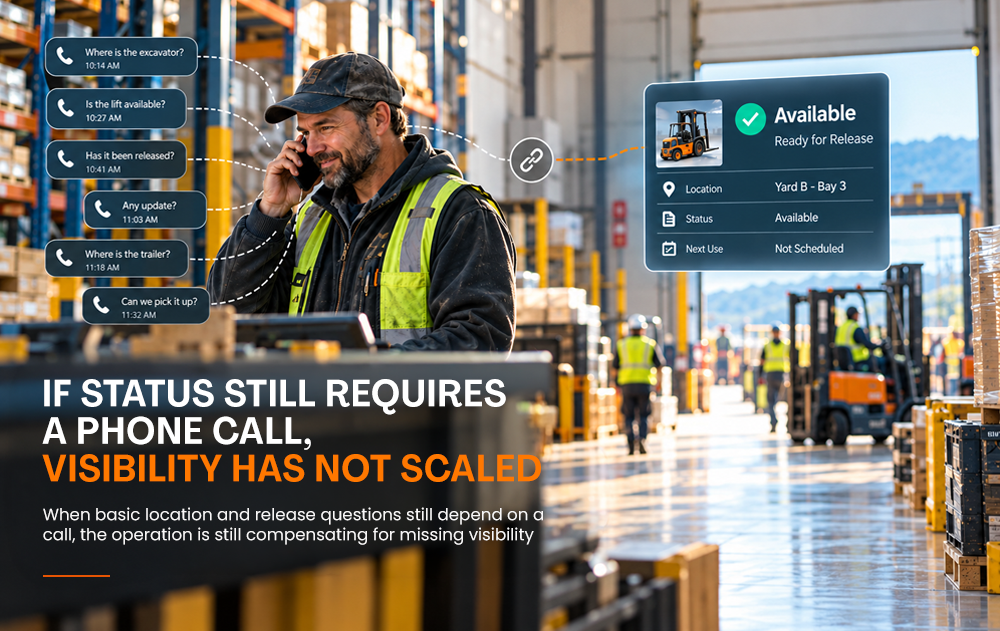

When customers repeatedly call for basic status updates – location, availability, release readiness, project inventory – the underlying issue is rarely a lack of willingness to help. It is a lack of shared visibility. The information the customer needs already exists somewhere inside the operation. It simply is not accessible to them, or even consistently accessible to your own team, without extra steps.
In equipment storage, rental, and logistics businesses, this pattern is common. And it scales poorly.
Why Routine Status Calls Keep Happening
Customers do not call for status updates because they enjoy the conversation. They call because they cannot see the answer themselves.
In a fragmented operation, location data, project association, movement history, and release status live in different places. The rental desk or customer-facing team may not have the same current view as the warehouse. Finance may be working from a different reference. The customer has no window into any of it.
So they call.
Each call is individually reasonable. Collectively, they consume capacity. Staff time that could be spent on higher-value work is spent reconstructing answers that should already be available. Response times stretch during busy periods. Customers who need a quick confirmation wait. Some of them stop waiting.
Industry patterns across logistics and distribution businesses show that routine inbound queries – status checks, inventory balances, release or delivery updates – often make up a large share of customer contact volume. When customers are given secure, real-time access to the information that already exists in the operation, those routine contacts drop substantially. Reductions in the range of 50-70% for routine query volume are commonly reported once self-service is properly connected to live operational data.
The key phrase is “properly connected.” A portal that shows outdated or incomplete information does not reduce calls. It generates more of them.
The Difference Between Service and Compensation
There is an important distinction that gets blurred in growing operations.
Answering a status call is service when the question genuinely requires judgment, exception handling, or a conversation.
Answering the same basic status question for the fifth time that week because the customer has no other way to see the information is compensation for missing visibility.
High-performing teams become very good at this compensation. They learn the workarounds. They know who to call. They can usually find the answer. The problem is that the organization becomes dependent on that skill. Growth adds more customers, more assets, and more concurrent questions. The same people absorb the load. The “service” starts to feel like constant firefighting.
Meanwhile, the customer experience remains reactive. Every update requires an interaction. Every interaction carries the risk of delay or incomplete information. Trust erodes quietly even when the final answer is correct.
What Changes When Customers Can See for Themselves
When location, status, project inventory, and release readiness are visible in a secure customer-facing view that draws from the same operational data the internal team uses, the pattern shifts.
Customers stop calling for information the system already knows.
They check their own project equipment.
They see what is stored, what is deployed, and what is ready for release.
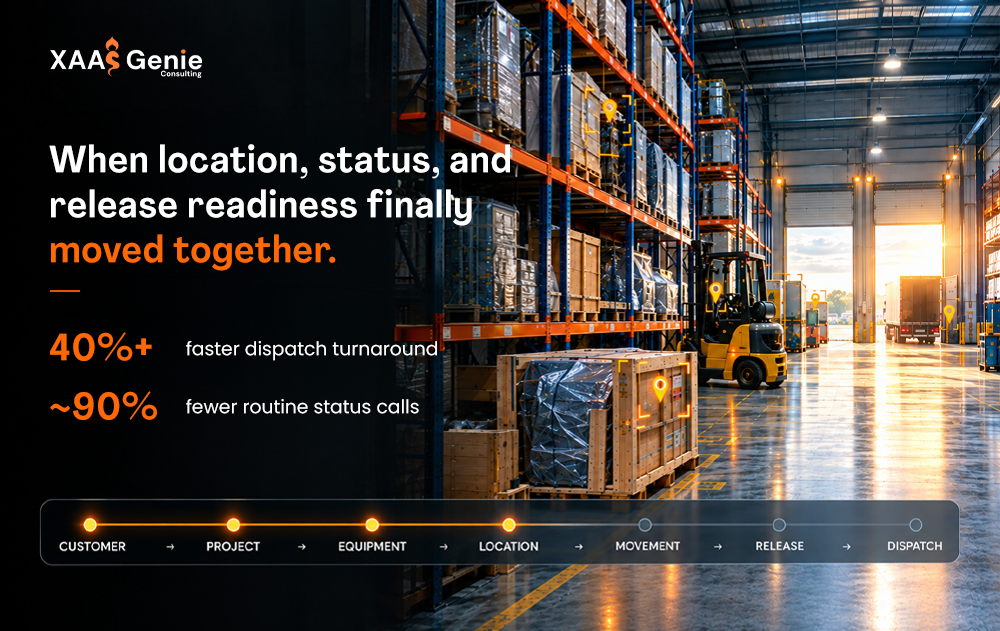
They submit release requests digitally instead of starting another phone thread. The volume of routine status inquiries falls. In one US equipment and logistics operation that connected warehouse execution with customer records and self-service visibility, routine customer status calls dropped by nearly 90%. Dispatch turnaround also improved by more than 40%, in part because release and status information no longer had to be chased.
The remaining calls tend to be higher-value: exceptions, changes, new requirements, genuine problems that need human judgment. The team’s time is spent where it creates the most impact.
This is not about removing human contact. It is about removing the need for human contact on questions that should not require it.
Why the Symptom Persists
Many operations recognize the volume of status calls and respond by adding more people to the phones or creating tighter internal response protocols. These measures can improve the experience of each call. They do not address the cause.
As long as the customer has no reliable window into their own equipment and project status, the calls continue. As long as internal teams must still reconstruct status from multiple sources before they can answer, the cost of each call remains high.
The root issue sits further back in the operating chain. When Customer → Project → Equipment → Location → Movement → Release → Dispatch is not connected, neither the customer nor the internal team has a single, trusted view. Status becomes something that has to be assembled rather than something that is simply available.
Process discipline and better phone etiquette cannot close that gap. Architecture can.
The Commercial Cost of the Symptom
Every routine status call carries a cost: staff time, delayed response to other work, and the cumulative effect on customer confidence. In competitive equipment storage, rental, and logistics markets, customers who repeatedly have to chase basic information eventually look for providers who make that information easier to access.
There is also an internal cost that is easy to underestimate. Teams that spend a significant portion of their day answering the same category of questions have less capacity for proactive work, exception handling, and growth. The operation feels busy. Much of the busyness is spent compensating for missing visibility.
Organizations that treat the volume of status calls as a service metric to be managed with more people or better scripts miss the larger signal. High volumes of routine status inquiries are evidence that visibility has not kept pace with the complexity of the business.
The Better Question to Ask
Instead of asking how to answer status calls faster, it is more useful to ask why the calls are necessary in the first place.
If customers call because they cannot see their equipment, project inventory, or release status, the solution isn’t better phone coverage. It is giving them, and the internal team, a reliable view of the same operational truth.
When that view exists, the calls drop. The remaining interactions become more valuable. The team stops compensating for missing information and starts operating with it.
Routine status calls are not a sign of attentive service.
They show the operation is still asking people to supply what the system should already make visible.