
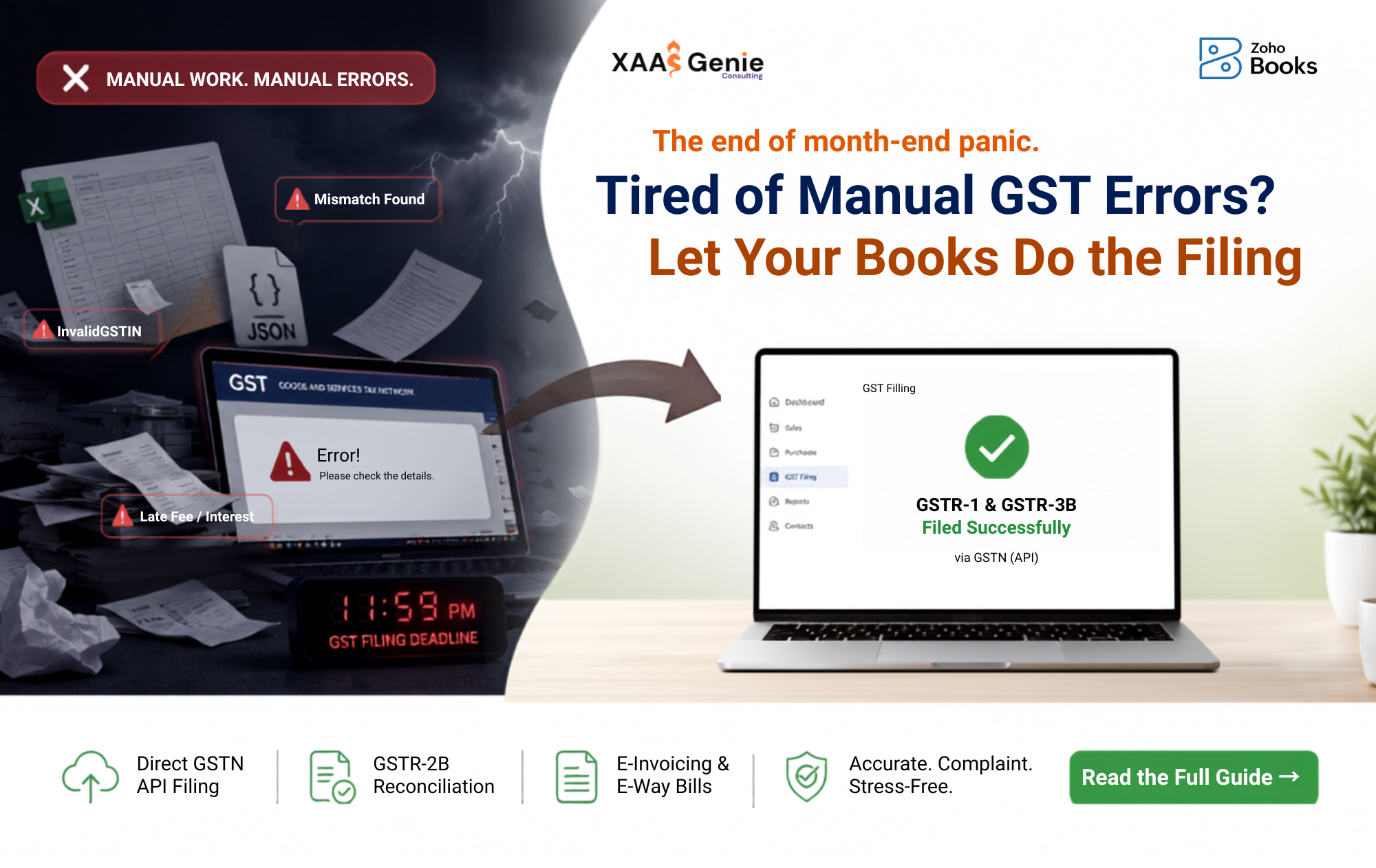
If you run a business in India, you know the drill all too well. Late nights spent reconciling invoices, exporting and re-formatting JSON files, manually punching numbers into the government portal, and frantically chasing mismatches in GSTR-2B. One small transcription typo, a flipped digit in a GSTIN or a misclassified HSN code, is all it takes to trigger late fees, heavy interest charges, or annoying notices from the tax department.
Manual compliance is stressful, time-consuming, and prone to human slip-ups. But it doesn't have to be this way.
By using a robust GST accounting software like Zoho Books, you can transform your tax cycle from a monthly nightmare into a streamlined workflow. As a registered GST Suvidha Provider (GSP) featuring direct API integration with the GST Network, Zoho Books India handles the heavy lifting so you don't have to.
Why Manual GST Filing is Costing Your Business More Than Just Time
Before diving into the solution, let's look at the actual toll manual processes take on MSME accounting software users and growing businesses:
- The Error Trap: Manual data entry opens the door wide for typos. A wrong tax split or a missing GSTIN can accidentally push B2B invoices into the B2C bucket, causing downstream headaches.
- ITC Leakage: Failing to properly match your purchase register with GSTR-2B means losing out on valuable Input Tax Credit (ITC), directly eating into your working capital.
- Compliance Risks: Delayed GSTR-3B filings attract daily late fees and compounding interest, while persistent mismatches can flag your business for audit risks.
Shifting to automated GST filing doesn't just save hours of labor; it acts as a financial safeguard for your enterprise.
How Zoho Books Cuts Manual Errors and Effort
Zoho Books for GST pulls data straight from your day-to-day transactions: sales invoices, credit and debit notes, purchases, and advances. Your returns are built organically from your live books, eliminating the need for separate spreadsheets.
Here is how specific Zoho Books GST compliance features make your life easier:
1. GST-Ready Invoices by Default
Enter your customer or vendor GSTINs just once. The system validates them automatically, applies the correct place-of-supply logic (CGST and SGST for intra-state, IGST for inter-state), and attaches the right HSN/SAC codes. Say goodbye to incorrect tax splits and missing details.
2. Direct GSTR-1 and GSTR-3B Filing
With a simple one-time setup, enabling API access on the GST portal (My Profile → Manage API Access) and configuring Online Filing Settings in Zoho Books with your GSTN credentials, you can push your GSTR-1 and GSTR-3B data, review it, and file directly from inside the dashboard. Authentication is handled seamlessly via OTP. No more downloading and uploading JSON files manually.
3. GSTR-2B Reconciliation for Accurate ITC
Fetch GSTR-2B data with a click, match it against your purchase register, and instantly flag discrepancies before you claim your Input Tax Credit. Because GSTR-2B is the ultimate source of truth for ITC, this feature alone protects you from clawbacks and disputes.
4. Built-In E-Invoicing and E-Way Bills
For businesses crossing the mandatory turnover threshold, Zoho Books generates IRN and QR codes via the IRP and effortlessly creates e-way bills right from your invoice screen in a matter of seconds.
Pro Tip: Built-in safeguards, multi-GSTIN setups, reverse-charge management, and annual return data preparation (GSTR-9) give you end-to-end coverage under one unified Zoho Finance Suite.
What a Typical Monthly Filing Flow Looks Like
Once you configure your account, your monthly compliance routine boils down to a few straightforward steps:
- Record Daily Transactions: Go about your month normally. Every invoice you create auto-carries its precise GST breakdown.
- Review and File GSTR-1: At period end, navigate to GST Filing → GSTR-1, review your auto-compiled sections (B2B, B2C, exports, nil-rated), push it to the GSTN, verify with an OTP, and file.
- Reconcile Purchases: Cross-check your purchase bills with your GSTR-2B statement.
- Finalize GSTR-3B: Review your outward liability, eligible ITC, and net tax payable summary, then push and file your GSTR-3B.
- Clear dues and complete: Pay any outstanding tax liability through the portal and mark the period closed in your books.
Instead of burning days of productive time, businesses using this cloud-based GST compliance solution typically wrap up their entire filing cycle in a couple of hours of calm review.
Getting Started with Zoho Books Implementation
Transitioning to tax compliance software doesn't require an army of consultants. Keep these setup essentials in mind:
- Make sure you are using the India edition of Zoho Books.
- Navigate to Settings → Taxes & Compliance → GST Settings to enter your GSTIN, select your business type (Regular, Composition, or SEZ), and define your filing frequency (monthly, quarterly, or QRMP).
- Complete your API access authorization on the official government portal (gst.gov.in).
- Map your inventory items with correct HSN/SAC codes and ensure your customer and vendor profiles have verified GSTINs attached.
Note: Full direct-filing capabilities and advanced reconciliation modules are generally available on Standard plans and above, while baseline GST invoicing features are accessible on entry-level tiers. Review current pricing structures to find the best fit for your company size.
Technology won't completely replace human oversight; you should always review your final figures, especially complex ITC claims and amendments, but it can strip away the tedious, repetitive steps that lead to costly mistakes under pressure.
If your team is still trapped in the exhausting cycle of exporting, uploading, and manual data reconciliation, it is time to upgrade. Implementing Zoho Books for your business means spending less time stressing over tax portals and more time doing what you do best: growing your enterprise.