
At Zoholics India 2026, this tension kept surfacing in our conversations with customers and prospects. It echoes questions our sales and leadership teams encounter in wider business discussions: how do we make our existing systems work together, reduce manual effort and give people information they can trust?
What stayed with us was how practical these conversations were. Customers wanted fewer obstacles between making a decision and getting the work done. Published research on workflows, data and adoption gives that concern further weight.
The question for leadership is immediate: where are people still doing work because our systems don’t?
The buying question has changed
Our customer conversations point to a shift in emphasis. Platform capability matters, but the more demanding question is whether that capability works across the business.
A sales commitment needs to reach delivery. An approval needs the right context. An operational update needs to reach finance without someone reconstructing the transaction. Leadership needs a reliable answer without commissioning another reconciliation exercise.
Behind requests for integration and automation, we hear a straightforward need: help us get the work done without so much chasing.
A new application can fill a genuine capability gap. But when the constraint is an unclear handoff or a process people avoid, adding software can leave the underlying problem intact.
Your people are paying the tax
When systems leave gaps, people absorb them. They re-key information, chase approvals, reconcile reports and explain why the numbers disagree.
We call that recurring burden the fragmented stack tax. It is the time, delay and uncertainty involved in making disconnected processes function.
Take a familiar example: sales confirms an order, operations checks a separate availability file, finance verifies the terms and a manager approves an exception in chat. Someone then assembles the customer update.
The transaction moves because people hold it together. As volumes increase, so does the coordination required.
That brings the issue into the boardroom. How much more business can we handle before we need another layer of checking, chasing and supervision?
A workaround can protect today’s delivery while concealing tomorrow’s capacity constraint.
Connected does not always mean usable
Moving data between systems is only part of the answer. People also need to know what it means and what happens next.
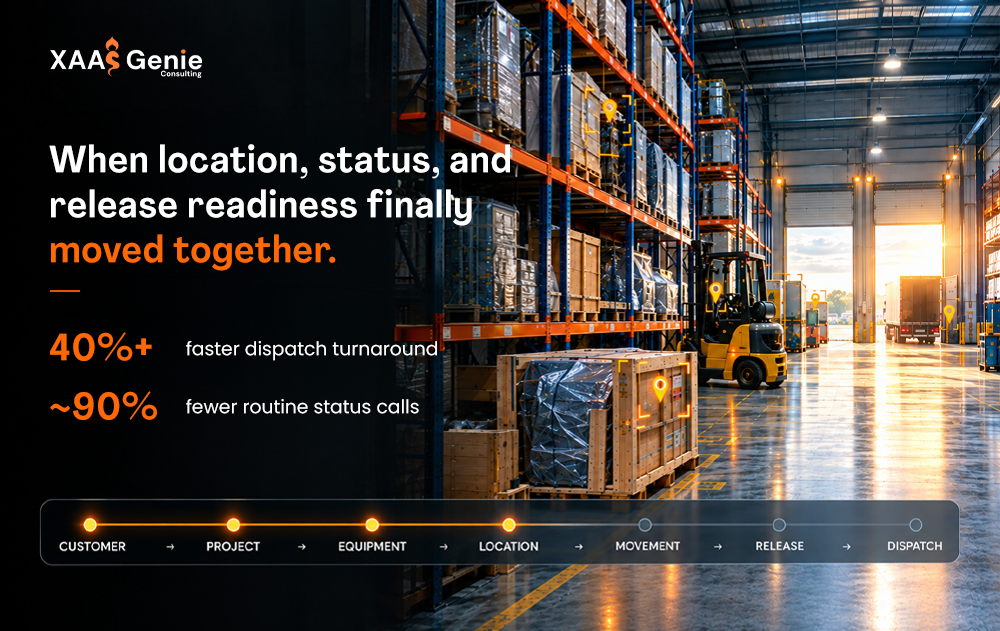
Available stock may not be ready for release. A closed opportunity may still need a delivery commitment. A purchase approval may leave the next action unclear.
People need to see the status, understand it and know who takes the next step.
The same applies to adoption. If an employee still relies on a parallel spreadsheet, we should ask what it provides that the formal system does not. It may be faster, clearer or better at handling exceptions. That is valuable design feedback.
What the research reinforces
McKinsey’s 2025 research found that workflow redesign had the strongest relationship with reported EBIT impact from generative AI among the 25 organizational attributes it examined. That supports a point running through our conversations: value depends on changing how work gets done.
Gartner’s April 2026 research reported that organizations with successful AI initiatives invested up to four times more, as a share of revenue, in foundations including data quality, governance, people and change management than those reporting poor outcomes.
These findings are consistent with the concerns we hear about reliable information and practical adoption. They are research associations, rather than promises of return or measurements of our customer base. Our reading is that workflow, data and adoption need to be addressed together.
AI inherits the gaps
AI can retrieve information, summarize exceptions and help people act. Its usefulness depends on knowing which data to trust, what a status means and which actions are permitted.
A conversational interface does not resolve conflicting records. An agent does not automatically settle unclear ownership.
Start with a defined business problem. Establish reliable information and clear controls. Then decide where automation or AI can make a measurable contribution.
Customers deserve a harder promise
The connected platform direction we observed at Zoholics raises the standard for implementation. Customers should be able to ask Zoho and its partners what will change in their daily operation.
Which manual dependency will disappear? Who owns the process across departments? How will exceptions be handled? What will demonstrate that people are using it and performance is improving?
We need to answer those questions at XAAS Genie too. Our recommendations should make clear what is holding the business back, what we propose to change and how the customer will know it has worked. Go-live matters. What happens in the working day afterwards matters just as much.
Show us the workaround
The most useful starting point may already be on someone’s desktop.
Show us the spreadsheet carrying a critical process. Walk us through the approval that depends on one person knowing the informal route. Tell us which report requires an explanation every month.
Trace the work, establish the baseline and address the constraint. Measure the change through cycle time, manual effort, exceptions or the time needed to produce a trusted answer.
That is the opportunity we see in these conversations: helping businesses grow without asking their people to spend more of the day holding their systems together.
Where is your business still relying on a workaround?
References and related reading
[1] XAAS Genie newsroom — Beyond the Apps: What We Heard at Zoholics India 2026, September 30, 2026
https://xaasgenie.com/beyond-the-apps-what-we-heard-at-zoholics-india-2026/
[2] McKinsey — The state of AI: How organizations are rewiring to capture value, 2025
https://www.mckinsey.com/capabilities/quantumblack/our-insights/the-state-of-ai-how-organizations-are-rewiring-to-capture-value
[3] Gartner — Organizations with Successful AI Initiatives Invest Up to Four Times More in Data and Analytics Foundations, April 16, 2026
https://www.gartner.com/en/newsroom/press-releases/2026-04-16-gartner-says-organizations-with-successful-ai-initiatives-invest-up-to-four-times-more-in-data-and-analytics-foundations