Why Businesses Choose Zoho Books for Accounting Success

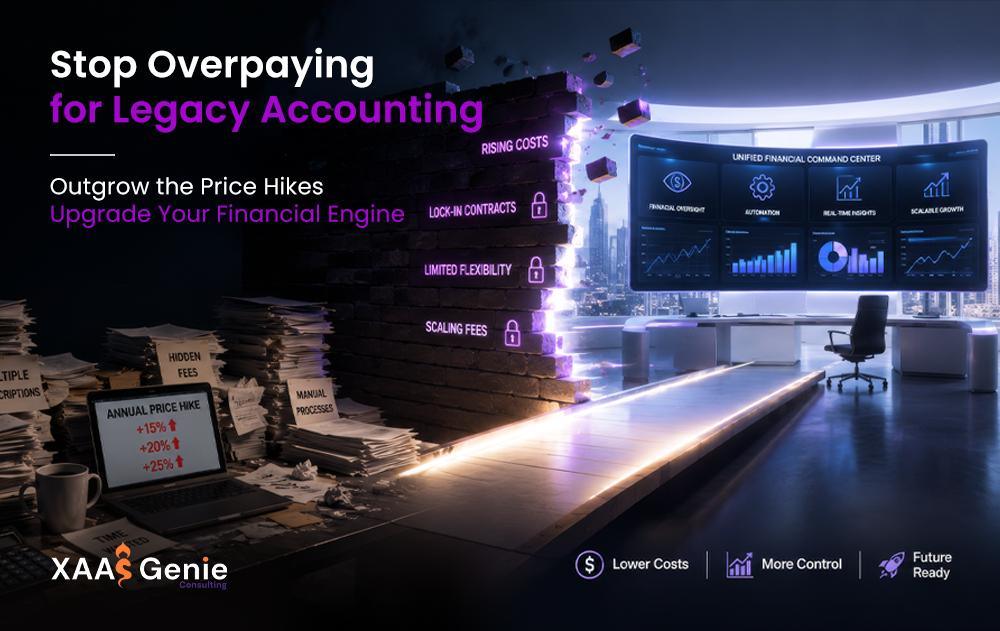
That friction is precisely why a massive market shift is underway. An increasing number of organizations are leaving platforms like QuickBooks Online behind in favor of Zoho Books. Businesses choose Zoho Books for accounting success because it delivers superior feature depth, advanced automation, and true scalability at 30% to 60% lower costs, all while integrating tightly into the broader Zoho ecosystem.

As an authorized Zoho Partner, XAAS Genie helps organizations unlock the full potential of these financial systems, transforming accounting from a back-office chore into a strategic growth engine.

  1. Escaping Legacy Price Hikes: Unmatched Value

For cost-conscious SMBs, startups, and expanding enterprises, software overhead can quickly eat into profit margins. While competitors are notorious for frequent subscription price increases and locking essential features behind expensive add-ons, Zoho Books takes a refreshing approach.

● Transparent, Lower-Cost Plans: Enjoy enterprise-grade functionality at a fraction of the cost, alongside a genuinely useful free tier for micro-businesses.

● Inclusive Base Features: Essential tools like inventory management and project tracking, which legacy platforms frequently treat as costly extras, are built right into the base plans, alongside support for more users out of the box.

  2. Robust Automation That Eliminates Manual Bottlenecks

Manual data entry is a primary culprit for financial discrepancies and wasted staff hours. Zoho Books changes the paradigm through a powerful, built-in automation engine that handles the heavy lifting.

Teams can set custom workflow rules for:

● Automated payment reminders and multi-tier invoice approvals

● Intelligent transaction categorization and custom field updates

● Instant email alerts for overdue accounts or budget thresholds

Powered by AI-assisted features for bank reconciliation and anomaly detection, your team spends less time fixing spreadsheets and more time driving business growth.

  3. Deep Integration with the Unified Zoho Ecosystem

Standalone accounting tools create dangerous data silos, forcing companies to rely on fragile integrations that introduce security gaps and extra expenses.

For companies utilizing the Zoho Business Suite, Zoho Books acts as the financial backbone of a unified operating system:

● CRM Synergy: Quotes and closed deals in Zoho CRM flow seamlessly into invoices without double-handling.

● Inventory Synchronization: Purchases and stock levels stay updated across departments in real time.

 Project Profitability: Project time and expenses roll directly into billing and detailed profitability reports.

  Comprehensive Core Features Without Compromise

Zoho Books strikes a rare balance between user-friendly design and robust enterprise capability, offering a complete financial toolkit:

  • Core Accounting: Full double-entry accounting, estimates, sales/purchase orders, bills, expenses, and journal entries.
  •  Global Operations: Multi-currency support equipped with real-time exchange rates for cross-border trade.
  • Native Inventory: Advanced warehouse, batch/serial tracking, and barcode scanning.
  • Project Accounting: Time tracking, milestone billing, and dedicated client portals.
  • Advanced Tax & Compliance: Built-in multi-region tax support, GST/HST filing, and sales tax automation.
  • Dimensional Analysis: Extensive customizable reporting and reporting tags that keep your chart of accounts clean.

 Scalability and Usability for Growing Teams

Whether you are organizing your first set of books or scaling operations internationally, Zoho Books scales fluidly. It bridges the gap between lightweight tools that businesses quickly outgrow and cumbersome, expensive ERP systems.

Coupled with a clean interface, robust mobile apps for on-the-go management, and granular role-based permissions, it fosters smooth collaboration between internal teams and external financial advisors.

  Common Trade-offs to Keep in Mind

Choosing the right financial software means evaluating your specific needs:

  • Learning Curve: Absolute novices migrating from basic spreadsheets may experience a brief initial adjustment period.
  • App Marketplace: Its native marketplace is curated around the Zoho suite, making external integrations more streamlined within the ecosystem rather than via massive legacy app stores.

Switching to a smarter accounting system requires strategic alignment with your business processes.

As an expert implementation and digital transformation partner, XAAS Genie helps you configure Zoho Books, integrate it seamlessly with your CRM and inventory tools, and customize workflows for maximum efficiency.

Ready to optimize your financial operations and reduce software overhead? Contact XAAS Genie today to start your journey toward seamless financial management.

Tired of Manual GST Filing Errors? Automate Compliance with Zoho Books

If you run a business in India, you know the drill all too well. Late nights spent reconciling invoices, exporting and re-formatting JSON files, manually punching numbers into the government portal, and frantically chasing mismatches in GSTR-2B. One small transcription typo, a flipped digit in a GSTIN or a misclassified HSN code, is all it takes to trigger late fees, heavy interest charges, or annoying notices from the tax department.

Manual compliance is stressful, time-consuming, and prone to human slip-ups. But it doesn’t have to be this way.

By using a robust GST accounting software like Zoho Books, you can transform your tax cycle from a monthly nightmare into a streamlined workflow. As a registered GST Suvidha Provider (GSP) featuring direct API integration with the GST Network, Zoho Books India handles the heavy lifting so you don’t have to.

  Why Manual GST Filing is Costing Your Business More Than Just Time

Before diving into the solution, let’s look at the actual toll manual processes take on MSME accounting software users and growing businesses:

● The Error Trap: Manual data entry opens the door wide for typos. A wrong tax split or a missing GSTIN can accidentally push B2B invoices into the B2C bucket, causing downstream headaches.

● ITC Leakage: Failing to properly match your purchase register with GSTR-2B means losing out on valuable Input Tax Credit (ITC), directly eating into your working capital.

● Compliance Risks: Delayed GSTR-3B filings attract daily late fees and compounding interest, while persistent mismatches can flag your business for audit risks.

Shifting to automated GST filing doesn’t just save hours of labor; it acts as a financial safeguard for your enterprise.

  How Zoho Books Cuts Manual Errors and Effort

Zoho Books for GST pulls data straight from your day-to-day transactions: sales invoices, credit and debit notes, purchases, and advances. Your returns are built organically from your live books, eliminating the need for separate spreadsheets.

Here is how specific Zoho Books GST compliance features make your life easier:

  1. GST-Ready Invoices by Default

Enter your customer or vendor GSTINs just once. The system validates them automatically, applies the correct place-of-supply logic (CGST and SGST for intra-state, IGST for inter-state), and attaches the right HSN/SAC codes. Say goodbye to incorrect tax splits and missing details.

  2. Direct GSTR-1 and GSTR-3B Filing

With a simple one-time setup, enabling API access on the GST portal (My Profile → Manage API Access) and configuring Online Filing Settings in Zoho Books with your GSTN credentials, you can push your GSTR-1 and GSTR-3B data, review it, and file directly from inside the dashboard. Authentication is handled seamlessly via OTP. No more downloading and uploading JSON files manually.

  3. GSTR-2B Reconciliation for Accurate ITC

Fetch GSTR-2B data with a click, match it against your purchase register, and instantly flag discrepancies before you claim your Input Tax Credit. Because GSTR-2B is the ultimate source of truth for ITC, this feature alone protects you from clawbacks and disputes.

  4. Built-In E-Invoicing and E-Way Bills

For businesses crossing the mandatory turnover threshold, Zoho Books generates IRN and QR codes via the IRP and effortlessly creates e-way bills right from your invoice screen in a matter of seconds.

Pro Tip: Built-in safeguards, multi-GSTIN setups, reverse-charge management, and annual return data preparation (GSTR-9) give you end-to-end coverage under one unified Zoho Finance Suite.

  What a Typical Monthly Filing Flow Looks Like

Once you configure your account, your monthly compliance routine boils down to a few straightforward steps:

  1. Record Daily Transactions: Go about your month normally. Every invoice you create auto-carries its precise GST breakdown.
  2. Review and File GSTR-1: At period end, navigate to GST Filing → GSTR-1, review your auto-compiled sections (B2B, B2C, exports, nil-rated), push it to the GSTN, verify with an OTP, and file.
  3. Reconcile Purchases: Cross-check your purchase bills with your GSTR-2B statement.
  4. Finalize GSTR-3B: Review your outward liability, eligible ITC, and net tax payable summary, then push and file your GSTR-3B.
  5. Clear dues and complete: Pay any outstanding tax liability through the portal and mark the period closed in your books.

Instead of burning days of productive time, businesses using this cloud-based GST compliance solution typically wrap up their entire filing cycle in a couple of hours of calm review.

  Getting Started with Zoho Books Implementation

Transitioning to tax compliance software doesn’t require an army of consultants. Keep these setup essentials in mind:

● Make sure you are using the India edition of Zoho Books.

● Navigate to Settings → Taxes & Compliance → GST Settings to enter your GSTIN, select your business type (Regular, Composition, or SEZ), and define your filing frequency (monthly, quarterly, or QRMP).

● Complete your API access authorization on the official government portal (gst.gov.in).

● Map your inventory items with correct HSN/SAC codes and ensure your customer and vendor profiles have verified GSTINs attached.

Note: Full direct-filing capabilities and advanced reconciliation modules are generally available on Standard plans and above, while baseline GST invoicing features are accessible on entry-level tiers. Review current pricing structures to find the best fit for your company size.

Technology won’t completely replace human oversight; you should always review your final figures, especially complex ITC claims and amendments, but it can strip away the tedious, repetitive steps that lead to costly mistakes under pressure.

If your team is still trapped in the exhausting cycle of exporting, uploading, and manual data reconciliation, it is time to upgrade. Implementing Zoho Books for your business means spending less time stressing over tax portals and more time doing what you do best: growing your enterprise.

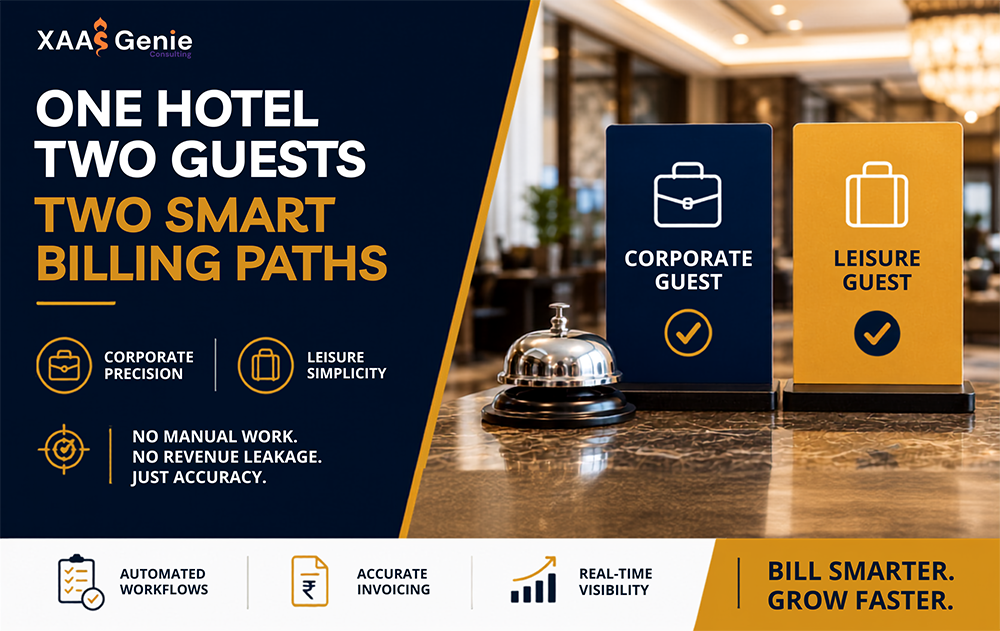
Corporate vs. Leisure: Customizing the Guest Billing Journey Using Zoho Creator

This leads to the “Integrated Nightmare”: the PMS, POS, and accounting software are all talking, but they aren’t listening to each other. The result? Duplicate data entry, revenue leakage, and an audit trail that relies more on human memory than systematic precision.

At XAAS Genie, we don’t just “set up a system.” We architect the billing logic within Zoho Creator to move beyond static templates and into intelligent, type-specific workflows.

The Problem: Why Standard Billing Breaks

When your billing process lacks a “business logic” layer, it fails to distinguish between the needs of different guest personas:

  • Corporate: Requires cost-center mapping, GST-compliant invoicing, and strict adherence to pre-approved rate cards.
  • Leisure/Group: Requires immediate payment integration, multi-item tax aggregation, and transparent self-service options.

Without a centralized architecture in Creator, your team is forced to manually reconcile invoices, which is where errors and disputes inevitably creep in.

The XG Angle: Architecting the Workflow

We replace manual intervention with a rule-based engine. When a booking enters the system, Zoho Creator doesn’t just store the data; it classifies it.

The Corporate Guest Workflow

For your corporate accounts, we shift the responsibility from the front desk to the system architecture. Our workflow triggers the following actions the moment a booking is created:

  1. Automated Entity Linking: The system identifies the guest as “Corporate,” instantly linking the booking to the specific Company Profile.
  2. Constraint Enforcement: Approved rate cards are applied at the point of entry. No more manual discounting or “guessing” the agreed price.
  3. Data Population: GST details and tax configurations are populated automatically, ensuring compliance from check-in.
  4. Cost Center Attribution: We assign charges to specific cost centers, simplifying internal reconciliation for the client.
  5. Consolidated Logic: The system aggregates all charges — stay, food, and ancillary services — into a single, consolidated invoice triggered at your chosen billing cycle, rather than per-stay.
  6. Credit Tracking: Automated flags track credit terms and due dates, eliminating the need for manual follow-up emails.

Building a Scalable Data Foundation

Using Zoho Creator’s capabilities, we move your operations from “data entry” to “demand orchestration”:

  1. Subform Aggregation: We use subforms to capture granular line items, room service, housekeeping, cab bookings, and map them directly to the correct bill object based on the guest type.
  2. Intelligent Record Templates: Instead of standard PDFs, we use custom record templates that pull dynamic fields, ensuring the invoice looks exactly how your corporate clients require it.
  3. The Guest Portal: We extend the journey by providing a secure Customer Portal. Corporate clients can log in to view their current outstanding amounts, download tax-compliant invoices, and track their entire billing history without calling your front desk.
  4. Deluge-Powered Reconciliation: We use custom Deluge scripts to bridge the gap between your operational data and your accounting software (like Zoho Books), ensuring that every dollar accounted for in the hotel is perfectly reflected in the ledger.

Stop Managing Spreadsheets, Start Architecting Systems

The difference between a hotel that struggles with billing and one that scales is the underlying architecture. By defining clear, automated paths for different guest types, you eliminate the friction that drives corporate clients away.

Your billing process shouldn’t be a manual task; it should be a background automation that runs with 100% precision.

Is your billing infrastructure ready to handle your growth?Reach out to XAAS Genie to see how we can re-architect your guest billing journey.

The “Fragmented Stack” Tax: Why 1 in 6 Projects Is Costing You More Than You’re Billing

It’s 7:00 PM. The office is quiet, the day’s fires have been put out, and you’re looking at a project report that should be a victory lap. Instead, you’re staring at the margins and wondering where they went. 

You know the work was high quality. You know your team delivered. But between the initial lead, the operations hand-off, and the final invoice, a hidden “tax” was paid. Data didn’t sync, communication broke down, and hours of billable expertise were sucked into the vacuum of manual data entry and rework. 

Industry data suggests that companies suffering from this kind of “software misalignment” lose anywhere from 10% to 15% of their project margins to invisible operational friction. Put simply: for every six projects you deliver, the equivalent of one entire project is being lost to the cracks between your systems. 

The “Silent Tax” Your Team is Paying Every Day 

We often blame these losses on “market conditions” or “growing pains.” But the real culprit is usually architectural debt. 

You started your business with a nimble, “duct-tape” stack, spreadsheets here, a basic CRM there. It got you to the first $1M. But those same tools are now acting as a ceiling. When your systems don’t talk to each other, your best people stop being creators and start being “human APIs,” manually moving numbers from one tab to another. 

That’s not just a drop in productivity; it’s a direct drain on your company’s valuation and your own sanity. 

Why Buying “The Next Big Tool” Won’t Save You 

When growth slows, the reflexive move is to buy more software. You add a new automation tool, a different project management platform, or a shiny AI plugin, hoping it will fix the flow.

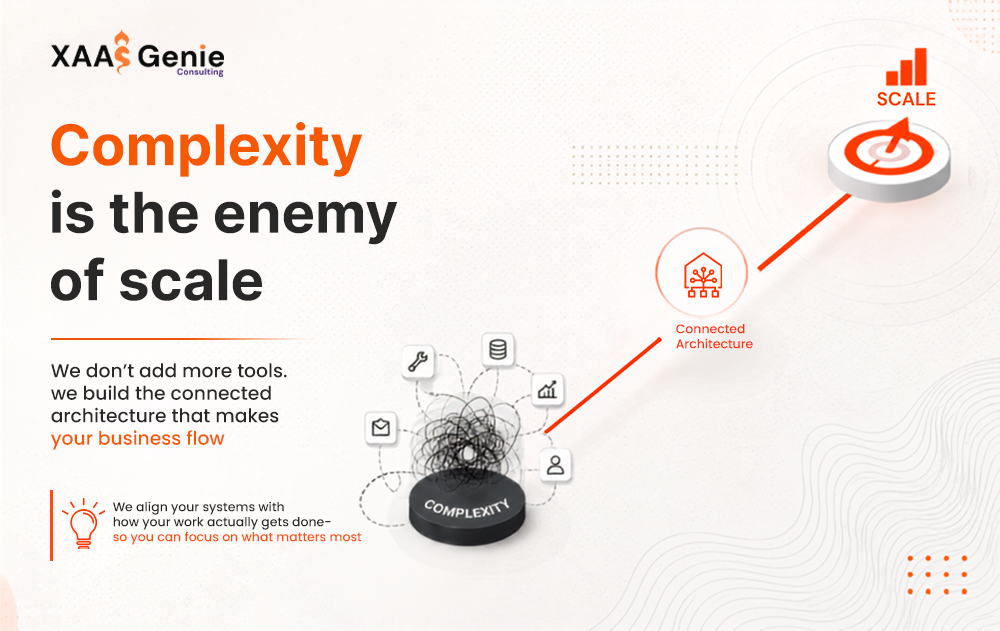
But adding more tools to a broken process is like adding more rooms to a house without fixing the hallways. You’re just creating a more complicated, more expensive, and more fragile mess. You don’t need more software, you need a better blueprint. 

We Don’t Implement Software, We Architect Your Flow 

 At XAAS Genie, we believe your systems should breathe the way your business does. 

We stop treating software as a box of features to be “implemented” and start treating your business as a living, breathing ecosystem. We aren’t here to be another vendor sending you invoices for seat licenses. We are here to act as your Business System Architect. 

We start by asking the only question that matters: How does work actually move through your organization? 

We map how a lead becomes a conversation, how a conversation becomes a project, and how a project turns into bottom-line revenue. Then, we build the architecture that supports that rhythm. We don’t force your team to fit into a template; we build the template to fit your team. 

Ready to Stop Being the “Human Bridge” Between Your Systems? 

When you align your systems with the reality of how your work gets done, the change is tangible. The friction disappears. Data flows without you having to push it. And most importantly, you stop being the “human bridge” between your departments. 

You get back to the part of the business that actually requires your vision. 

If you’re ready to stop “using” software and start “architecting” growth, let’s have a conversation. No sales pitch, no feature demos—just a frank look at where the “fragmented stack” tax is eating into your margins and how we can clear it out. 

Why Your Production Planning Keeps Falling Short and How Zoho CRM Sales Forecasting Fixes It

In most manufacturing organisations, there is a silent, costly divide. On one side, the sales team is chasing targets, managing the pipeline, and closing deals. On the other, the production team is fighting fires, trying to balance inventory levels, manage raw materials, and hit delivery schedules based on nothing more than “gut feeling” or historical spreadsheets. 

When these two worlds don’t speak the same language, the result is predictable: over-production that ties up capital, or stockouts that alienate your best customers. 

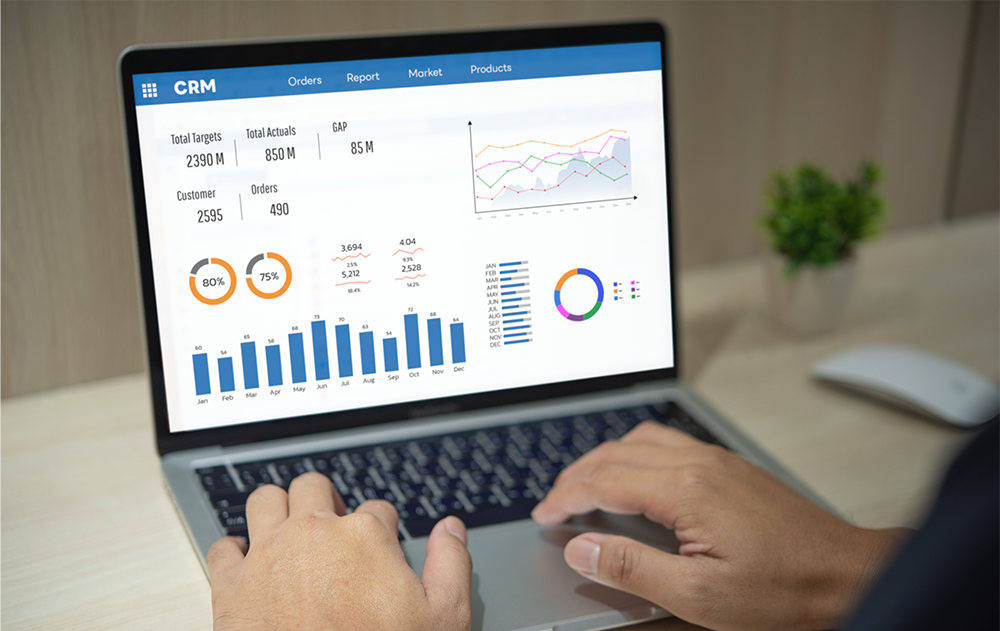
The missing link isn’t just better communication, it’s a unified system. It starts with leveraging Zoho CRM Sales Forecasting to turn your sales pipeline into a reliable map for your production floor. 

 What Does Zoho CRM Actually Do? 

Before we talk about forecasting, let’s clear the air on what the CRM is. It’s not just a digital Rolodex for your sales reps. In a connected enterprise, Zoho CRM acts as the central nervous system for your entire business. 

It tracks every customer interaction, monitors deal velocity, and maintains a clean record of what is coming down the pipe. When the CRM is correctly architected, it serves as the single source of truth that connects your front-end customer engagement directly to your back-end operational execution. 

Empowering the Manufacturing and Production Teams 

For a production manager, a CRM is typically a “black box” that they ignore until a crisis hits. We change that. By integrating the CRM into the manufacturing workflow, you provide your production teams with: 

● Proactive Visibility: Instead of waiting for a manual email about a new order, production teams can see potential deals moving through the stages in real-time.

● Reduced Friction: When sales and production are aligned on the same platform, you eliminate the “he-said-she-said” regarding lead times and capacity.

● Data-Driven Readiness: The team can prepare labor, machines, and materials based on the probability of a deal closing, rather than reacting only after the contract is signed.

Mastering AI Sales Forecasting in Zoho CRM 

This is where the manual guesswork ends. Sales Forecasting in Zoho CRM, powered by Zia, its AI assistant, transforms raw data into actionable intelligence. 

Unlike traditional methods that rely on simple averages, Zia uses machine learning to analyse historical sales patterns, pipeline health, and market trends. It identifies which deals are likely to close, which are at risk, and where the gaps lie between your current trajectory and your production targets. 

By utilising AI sales forecasting software, you aren’t just looking at what happened last year; you are looking at a predictive model of what is likely to happen next quarter. This allows you to: 

● Optimise Inventory: Use predictive sales analytics to align your stock levels with forecasted demand, helping to reduce stock shortages with AI sales forecasting.

● Bridge the Gap: Use AI in Production Planning to simulate “what-if” scenarios, allowing you to adjust your production schedule before a supply chain bottleneck ever happens.

● Tailored Accuracy: For manufacturers, standard forecasting isn’t enough. With Zoho CRM predictive analytics for manufacturing companies, you can build custom models that account for product-specific demand cycles and seasonal shifts.


Building a Connected Operating System 

The goal isn’t just to implement a tool; it’s to build a system that orchestrates your growth. Production planning with Zoho CRM is most effective when it is part of a larger, integrated architecture, connecting your CRM to your inventory systems, ERP, and shop floor execution. 

When your forecasting is precise, your production becomes leaner, your capital remains liquid, and your team stops firefighting and starts scaling. 

 Is your current sales-to-production link broken? 

At XAAS Genie, we specialise in architecting these systems for manufacturing leaders. We don’t just implement software; we build the growth infrastructure that connects your boardroom to the shop floor. 

How Manufacturers Can Cut Lead-to-Order Time by 50% Using Zoho CRM Automation

In the modern manufacturing landscape, speed is the ultimate competitive advantage. While global supply chains have become more interconnected and digital, the internal processes for many manufacturers remain anchored in legacy methods. The journey from an initial prospect inquiry to a finalised production order is often plagued by “dead air”, those silent periods where information is stuck in transit between sales representatives, engineering teams, and the shop floor.

When a manufacturer relies on disconnected spreadsheets, fragmented email chains, and siloed communication, lead-to-order time inevitably stretches, costing both margins and customer trust. To remain competitive, organisations must move away from generic data entry and toward intelligent business system architecture. By deploying Zoho CRM automation for manufacturers, companies can bridge the critical gap between sales and production, ensuring that every opportunity moves through the pipeline with precision and velocity.

The Hidden Cost of Manual Handoffs 

The most significant friction in a manufacturing cycle occurs during the handoff. A sales representative receives a complex inquiry, but they lack visibility into current raw material availability or shop floor capacity. They must email production, wait for a response, draft a quote, and then manually re-enter data into a secondary system. 

This process is not only slow; it is inherently prone to error. Each manual entry point acts as a bottleneck that accumulates delay. When an organization uses standard, unoptimised manufacturing CRM software, it often fails to account for the technical nuances of the industry, such as Bill of Materials (BOM) management, custom product configurations, and multi-stage production scheduling. 

Failing to automate the sales pipeline in manufacturing leads to a “Black Box” effect. Sales teams operate without knowing if they are promising a delivery date that production can actually meet. The result is a cycle of over-promising and under-delivering, which ultimately damages the brand’s reputation. 

Building a Unified Revenue Architecture 

True efficiency in the manufacturing sector is not achieved through off-the-shelf software; it is achieved through strategic implementation. A successful Zoho CRM implementation for manufacturing treats the CRM as the central nervous system of the organisation, not just a glorified contact list. 

1. Precision Lead Tracking and Qualification 

Generic lead management is insufficient when a single lead represents a multi-million dollar contract. Specialised manufacturing lead tracking software must do more than just store names and numbers. It must categorise prospects by their technical requirements, product compatibility, and potential volume. 

By automating the qualification process, sales teams can instantly distinguish between casual inquiries and high-intent requests. When a lead enters the system, automated scoring rules can verify if the prospect aligns with existing production capabilities. This ensures that the sales team spends their time on deals that are actually executable, drastically reducing the time wasted on misaligned inquiries. 

2. Automating the Sales Pipeline for Maximum Throughput 

The goal of any automated pipeline is to minimize the “time-to-quote.” Through intelligent workflow rules, a CRM can automatically trigger an alert to the engineering team the moment a quote request hits a specific threshold. 

When organizations automate the sales pipeline in manufacturing, they eliminate the need for manual status updates. For example, when a deal moves to a “Configuration Required” stage, the system can automatically pull the necessary technical documents or trigger a request for a custom BOM estimate. This creates a seamless flow of information that keeps the momentum behind every deal. 

3. Engineering Customisation for Complexity 

Manufacturing is rarely “one-size-fits-all.” The most effective systems utilise Zoho CRM customisation for manufacturers to reflect the unique complexity of the shop floor. Custom modules can be built to handle specific product hierarchies, ensuring that when a product is selected, the CRM automatically pulls the correct pricing, lead time, and technical specifications. 

This level of customisation transforms the CRM from a passive record-keeper into an active participant in the revenue process. It allows sales teams to provide accurate, data-backed quotes in minutes rather than days, drastically reducing the lead-to-order time. 

Why Zoho CRM for the Manufacturing Industry? 

The manufacturing sector demands a system that is as robust as the products being built. Using Zoho CRM for the manufacturing industry provides a scalable foundation that can grow alongside the business. Unlike rigid legacy systems, the Zoho ecosystem allows for deep integrations with ERP (Enterprise Resource Planning) systems and inventory management tools. 

This integration is where the real value lies. When the CRM is synced with production data, the sales team gains real-time visibility into stock levels and production queues. They can provide clients with accurate, live shipping estimates. This transparency builds trust and significantly shortens the sales cycle. 

Furthermore, by utilising advanced analytics within the CRM, leadership can identify exactly where the pipeline is stalling. Are quotes getting stuck in the engineering review stage? Is there a delay between contract signature and production commencement? Data-driven insights allow for continuous process improvement, ensuring that the organization is always refining its efficiency. 

Moving Toward a Proactive Future 

The transition from a reactive sales process to a proactive, automated revenue system is a significant undertaking, but it is necessary for survival in the current market. Manufacturers that continue to rely on manual processes will find themselves outpaced by competitors who have embraced digital transformation. 

Reducing lead-to-order time is not just about making the sales team faster; it is about aligning the entire organisation toward a singular goal: faster delivery and higher customer satisfaction. By architecting a system that connects sales, engineering, and production, manufacturers can create a predictable, scalable revenue machine. 

Effective CRM utilisation is about creating a flow that is frictionless, transparent, and data-driven. When the technology is properly aligned with business objectives, the results are measurable: shorter cycles, higher win rates, and a significantly more agile manufacturing operation. It is time to move beyond the constraints of spreadsheets and embrace a future built on intelligent automation. 

The Enterprise Blueprint for a Self-Governing Shop Floor

The reality of most mid-market manufacturing plants is that they don’t run on software; they run on adrenaline and the physical presence of three key people: your plant manager, production supervisor, and operations head.

If one of them calls in sick, takes a weekend off, or gets pulled into an all-day client meeting, the factory floor slows down. Approvals grind to a halt, reporting stalls, inventory discrepancies pile up, and critical escalations hang in limbo.

When leadership asks fundamental questions, the answers shouldn’t require tracking down a supervisor:

  • What is today’s actual production output?
  • Which machine is down on Floor 2?
  • Which customer order is delayed, and why?
  • What is our exact material rejection rate this week?

Relying on human gatekeepers for routine oversight creates an operational bottleneck. To scale your manufacturing operation without a proportional spike in management overhead, you don’t need more supervisors on the floor. You need an architecture that monitors, flags, and acts autonomously.

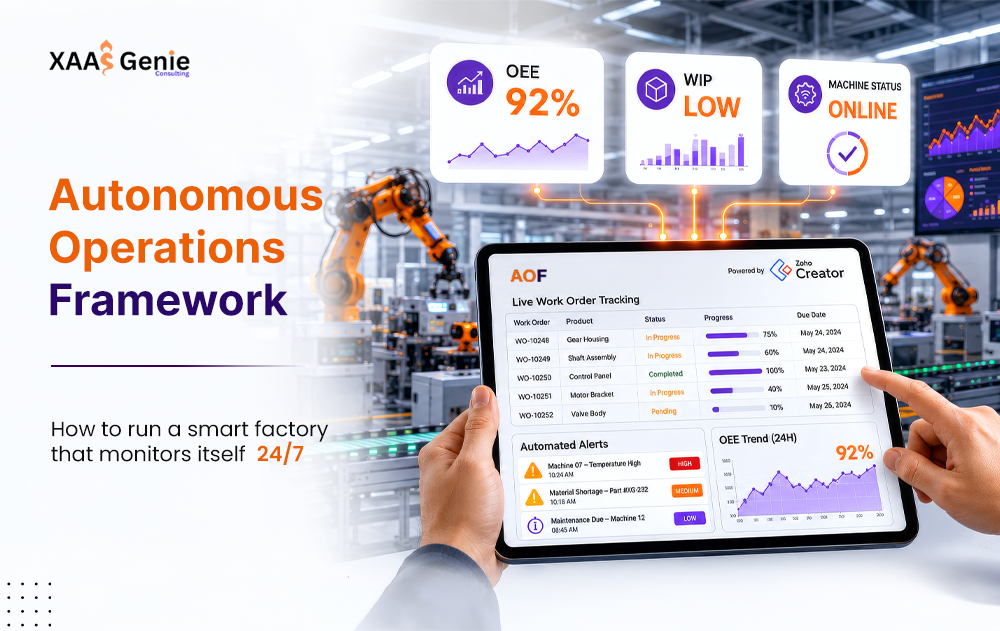
At XAAS Genie, we address this with the XAAS Genie Autonomous Operations Framework™.

Shifting from Human Oversight to Systemic Vigilance

When we talk about an automated architecture, we aren’t talking about replacing the human intelligence on your shop floor. We are talking about liberating it. Traditional plant management relies heavily on physical presence, a manager walking the line, checking clipboards, and catching errors by sight.

But true operational resilience happens when your processes are governed by a system that doesn’t need to rest, eat, or step away from the floor.

This exact shift in perspective is what inspired our core architecture. The framework itself was organically defined by one of our clients, Rachith Goel, Director at Radiant Anodisers. When we deployed this automated system across his manufacturing facility, he gave the framework a unique, practical nickname: his “Sleeping Manager”.

He described it as a digital backbone that is “always there, taking care of things, without being in your face.” For the team at Radiant Anodisers, this framework is so deeply woven into their daily workflows that running production for even a single day without it would cause severe logistical setbacks. It acts as a vigilant, 24/7 digital supervisor that quietly enforces your operational protocols, freeing your actual leadership team from playing telephone with status updates so they can focus on true production optimisation.


The Stack: Building an Autonomous Factory on Zoho Creator

Many enterprise manufacturing systems (ERPs) are rigid, expensive, and notoriously difficult for shop-floor workers to use. That is why we architect the framework using Zoho Creator for manufacturing.

As a low-code platform, Zoho Creator allows us to build a highly tailored, agile Zoho Creator manufacturing ERP that fits your exact processes, whether you handle custom job-work, high-volume assembly, or complex surface treatments, without the bloated code or multi-year rollout timelines of traditional software.

When combined into a unified operational engine, we map out a multi-layered architecture that completely digitises your production cycle:

1. Data Layer (The Single Source of Truth)

Before a system can automate, it needs flawless data. We design custom forms and unified databases to manage master data (Customers, Vendors, Bills of Materials, active Machinery, and Drawings) and Transactional Forms (Purchase Orders, Material Inward Receipts, Job Work Challans, and Multi-stage Work Orders).

2. Process Layer (Manufacturing Workflow Automation)

This is where the autonomous engine comes alive. Using Zoho’s native Deluge scripting, we build deep manufacturing workflow automation that eliminates manual data handoffs:

  • Order-to-Cash Automation: As soon as a Sales Order is approved, the system automatically generates a corresponding Job Order/Challan and routes it to the correct production line.
  • Dynamic Status Triggers: The moment an operator completes a phase (e.g., Pre-Production → Production → QC), the system automatically updates the material location and assigns the next task to the next workstation.
  • Auto-Consumption: Raw materials are systematically deducted from Work-in-Progress (WIP) inventory based on real-time production logs, keeping stock counts accurate.

3. Intelligence Layer (Real-Time Dashboards & Alerts)

If a critical machine overheats or an order misses its gate deadline, you shouldn’t have to wait for the evening shift report to find out.

  • Real-Time Production Dashboard: Displays live yields, live work order tracking, and dynamic batch statuses.
  • Machine Status Monitoring: Instantly flags downtime or drops in Overall Equipment Effectiveness (OEE).
  • Automated Alerts: If a delay risk occurs or an inspection triggers a quality rejection, the framework bypasses traditional channels to send instant alerts via SMS, Email, or WhatsApp directly to the stakeholder who can fix it.

Moving from Firefighting to Smart Factory Automation

Shifting from manual oversight to smart factory automation yields immediate, measurable returns that protect your plant’s bottom line:

  • Proactive Resolution: Automated exception alerts flag threshold deviations immediately, allowing you to course-correct in minutes rather than discovering a bottleneck days late.
  • Audit-Ready Traceability: A complete digital footprint links every batch to the raw material lot, machine used, operator on shift, and QC sign-off.
  • Frictionless Scaling: The digital backbone absorbs increased operational volume with zero added managerial overhead.

Let Your Factory Run Itself

What if your production facility could monitor its own health, escalate processing issues automatically, track inventory valuation in real time, and generate complete management reports while your leadership team focuses on business growth?

Stop letting operational details stall your progress when your key people are away. Turn Zoho Creator into your digital, always-on operations manager.

Ready to systematically eliminate your production bottlenecks? Connect with the XAAS Genie team today to map out a custom Autonomous Operations Framework for your plant.

Transforming Luxury Travel Operations with Low-Code No-Code Solutions

For boutique travel agencies, destination management companies, luxury tour operators, and specialized travel consultants, meeting these expectations requires more than exceptional customer service. It requires digital transformation.

However, many travel businesses continue to rely on spreadsheets, disconnected systems, manual workflows, and outdated processes that limit growth and reduce operational efficiency.

At XAAS Genie, we help travel organizations embrace digital transformation through customized Low-Code No-Code Solutions companies that streamline operations, automate workflows, improve customer engagement, and create scalable business models for long-term growth.

The Digital Challenges Facing Luxury Travel Operators

Luxury travel businesses operate in a highly competitive environment where customer expectations are constantly increasing.

Today’s travelers demand:

  • Personalized itineraries
  • Instant booking confirmations
  • Real-time travel updates
  • Mobile accessibility
  • Secure digital transactions
  • Seamless communication

At the same time, travel operators must manage a complex ecosystem of suppliers, accommodations, transportation providers, booking platforms, and customer interactions.

Common challenges include:

Budget Limitations

Many boutique travel operators lack the resources required for large-scale technology investments or traditional software development projects.

Disconnected Business Processes

Critical business functions such as lead management, booking administration, invoicing, customer communications, and supplier coordination often operate across multiple disconnected systems.

Increasing Operational Complexity

Managing luxury travel experiences involves coordinating numerous services while maintaining accuracy, responsiveness, and exceptional service quality.

Data Security Requirements

Handling customer passports, payment information, travel preferences, and personal details requires secure and compliant systems.

Competitive Pressure

Larger travel organizations often have access to advanced technology platforms, making it challenging for smaller operators to compete effectively.

These challenges highlight the growing need for flexible and affordable technology solutions.

Why Low-Code No-Code Solutions Are Reshaping the Travel Industry

Traditional software development often requires significant investment, lengthy implementation cycles, and dedicated technical resources.

Low-Code No-Code Solutions provide a modern alternative that enables travel businesses to build custom applications and automate processes without extensive coding.

These platforms empower organizations to:

  • Develop applications faster
  • Reduce operational costs
  • Improve business agility
  • Enhance customer experiences
  • Automate repetitive tasks
  • Scale operations efficiently

At XAAS Genie, we leverage leading Low-Code No-Code platforms such as Zoho Creator to help travel businesses accelerate innovation and digital transformation.

Digital Trends Driving the Future of Luxury Travel

Intelligent Booking and Reservation Systems

Travelers expect instant access to travel information and booking confirmations.

Modern reservation systems enable:

  • Real-time availability tracking
  • Automated booking confirmations
  • Dynamic pricing
  • Secure payment processing
  • Centralized itinerary management

Low-Code No-Code Solutions allow travel businesses to customize booking workflows based on their unique business requirements.

AI-Powered Customer Service

Artificial Intelligence is transforming customer engagement in the travel industry.

AI-powered virtual assistants can:

  • Handle inquiries 24/7
  • Provide personalized recommendations
  • Assist with booking requests
  • Deliver travel alerts
  • Improve response times

This allows travel consultants to focus on high-value customer interactions while routine requests are automated.

Mobile-First Travel Experiences

Luxury travelers increasingly manage their journeys through mobile devices.

Travel businesses need:

  • Mobile-friendly portals
  • Digital itineraries
  • Instant notifications
  • Direct communication channels
  • Personalized travel experiences

XAAS Genie helps organizations develop mobile-enabled travel solutions using Low-Code No-Code technology.

Data-Driven Personalization

Customer expectations continue to shift toward hyper-personalized experiences.

By leveraging analytics and customer data, travel operators can:

  • Understand traveler preferences
  • Recommend tailored experiences
  • Predict customer needs
  • Increase customer loyalty

Data-driven personalization creates stronger relationships and higher conversion rates.

Secure Digital Transactions

Security remains a top priority for luxury travel businesses.

Modern digital platforms support:

  • Secure payment processing
  • Fraud prevention
  • Customer data protection
  • Regulatory compliance

These capabilities help build trust and improve customer confidence.

Virtual and Augmented Reality Experiences

Innovative travel businesses are using VR and AR technologies to offer immersive previews of destinations, accommodations, and travel experiences.

These technologies help customers visualize their journeys before booking and improve decision-making.

Beyond Customer Experience: Optimizing Internal Operations

Digital transformation is not limited to customer-facing technologies.

Travel organizations can achieve significant improvements by optimizing internal business processes.

Workflow Automation

Many travel businesses spend valuable time managing repetitive tasks.

Low-Code No-Code Solutions enable automation of:

  • Booking approvals
  • Itinerary creation
  • Customer notifications
  • Invoice generation
  • Supplier communications
  • Travel documentation

Automation improves efficiency while reducing manual errors.

Centralized Business Management

Disconnected systems often create information silos that limit visibility.

XAAS Genie helps travel businesses build centralized platforms that connect:

  • CRM systems
  • Booking platforms
  • Finance systems
  • Supplier networks
  • Customer communications

This creates a single source of truth across the organization.

Scalability for Growth

As travel businesses expand, operational complexity increases.

Our Low-Code No-Code Solutions provide the flexibility and scalability required to support business growth without significant technology investments.

How XAAS Genie Accelerates Travel Industry Digital Transformation

XAAS Genie combines industry expertise with innovative technology solutions to help travel businesses modernize operations.

Our services include:

Custom Low-Code No-Code Application Development

We build tailored applications designed specifically for travel and tourism businesses.

Business Process Automation

We automate workflows to improve efficiency and reduce operational bottlenecks.

Digital Transformation Consulting

We help organizations develop strategic roadmaps for technology adoption and operational excellence.

System Integration

We connect existing systems and applications to improve visibility and collaboration.

Business Process Management

We optimize processes to enhance productivity, customer satisfaction, and profitability.

Benefits of Low-Code No-Code Solutions for Travel Businesses

Organizations adopting Low-Code No-Code Solutions often experience:

Improved Customer Satisfaction

Faster responses and personalized services create better customer experiences.

Increased Operational Efficiency

Automation reduces administrative workload and improves productivity.

Lower Operating Costs

Digital workflows eliminate inefficiencies and reduce manual effort.

Faster Innovation

Businesses can quickly launch new services and adapt to market changes.

Better Decision-Making

Real-time dashboards and analytics provide valuable business insights.

Competitive Advantage

Technology enables travel businesses to differentiate themselves in an increasingly competitive market.

The Future of Luxury Travel Is Digital

Digital transformation is no longer a future initiative—it is a business necessity.

Luxury travel operators that embrace Low-Code No-Code Solutions can deliver exceptional customer experiences while improving operational efficiency and profitability.

At XAAS Genie, we help travel businesses leverage technology to simplify complexity, automate operations, and unlock new growth opportunities.

By combining process excellence, workflow automation, and Low-Code No-Code innovation, we empower travel organizations to build agile, scalable, and future-ready businesses.

Conclusion

The luxury travel industry is entering a new era defined by personalization, automation, and digital innovation.

Travel businesses that invest in digital transformation today will be better positioned to meet evolving customer expectations and drive sustainable growth tomorrow.

XAAS Genie is proud to help travel organizations navigate this transformation journey through customized Low-Code No-Code Solutions that enhance customer experiences, optimize operations, and create lasting competitive advantages.

The future of travel is connected, intelligent, and digital—and XAAS Genie is helping businesses lead the way.

Empowering Travel Businesses Through Low-Code No-Code Solutions: A Digital Transformation Journey

However, as the travel industry becomes increasingly competitive and customer expectations continue to rise, travel agencies and corporate travel companies are facing mounting operational challenges. Manual processes, spreadsheet-based operations, disconnected systems, and inefficient workflows often limit their ability to scale and deliver exceptional customer experiences.

At XAAS Genie, we believe that digital transformation powered by Low-Code No-Code Solutions is helping travel businesses modernize operations, improve efficiency, and create better customer experiences.

The Growing Complexity of Travel Operations

Modern travel businesses manage a wide range of services, including:

  • Flight Bookings
  • Hotel Reservations
  • Corporate Travel Management
  • Sightseeing Packages
  • Visa Assistance
  • Travel Insurance
  • Transportation Services
  • Foreign Exchange Coordination

Managing these services efficiently requires significant coordination across multiple stakeholders, suppliers, and customers.

Many travel companies continue to rely on manual workflows that create operational bottlenecks and limit business growth.

Common Challenges Faced by Travel Agencies

Lead and Opportunity Management

Travel consultants must continuously manage inquiries, follow-ups, customer preferences, and sales pipelines while ensuring no opportunity is missed.

Manual Quotation Generation

Creating customized travel packages and quotations often requires extensive manual effort, leading to delays and inconsistencies.

Invoice and Financial Management

Travel businesses must generate GST-compliant invoices while handling multiple service categories, vendors, commissions, and customer-specific pricing structures.

Currency Fluctuation Management

International travel services require constant monitoring of foreign exchange rates to ensure pricing accuracy and profitability.

Travel Voucher Processing

Timely generation and delivery of travel vouchers, tickets, itineraries, and supporting documents are critical for customer satisfaction.

Limited Operational Visibility

Without centralized systems, management teams often struggle to monitor bookings, revenue performance, pending payments, customer interactions, and employee productivity.

These challenges create the need for a more intelligent and scalable business management approach.

Why Low-Code No-Code Solutions Are Transforming the Travel Industry

Traditional software development projects often require significant investment, long development cycles, and extensive technical resources.

Low-Code No-Code Solutions provide a faster and more cost-effective alternative by enabling organizations to rapidly build customized business applications with minimal coding.

These platforms help travel companies accelerate digital transformation by:

  • Automating repetitive processes
  • Improving operational efficiency
  • Enhancing customer experiences
  • Reducing administrative overhead
  • Increasing business agility

XAAS Genie’s Digital Transformation Approach

At XAAS Genie, we recently partnered with a corporate travel company to build a comprehensive travel management platform using Zoho Creator, one of the industry’s leading Low-Code No-Code Solutions platforms.

Our goal was to simplify complex business processes while providing management with complete visibility across operations.

Rapid Application Development

Using Zoho Creator’s Low-Code No-Code capabilities, we rapidly developed customized workflows tailored to the client’s operational requirements.

The platform was designed to automate:

  • Lead Management
  • Quotation Generation
  • Invoice Processing
  • Travel Voucher Management
  • Customer Communication
  • Supplier Coordination

This significantly reduced manual effort while improving process consistency.

Automating Complex Business Rules

Travel pricing often involves multiple variables, including:

  • Customer categories
  • Package configurations
  • Service combinations
  • Foreign exchange rates
  • Vendor-specific pricing

Through intelligent workflow automation, XAAS Genie helped automate these calculations, reducing errors and improving operational efficiency.

Seamless Digital Adoption

Transitioning from spreadsheets to a digital platform can be challenging.

Our team worked closely with stakeholders to ensure smooth onboarding through:

  • User training
  • Process mapping
  • Data migration
  • Workflow optimization

This ensured high user adoption and a successful digital transformation journey.

Integrated Document Management

To improve operational control and compliance, the solution included integrated document management capabilities for:

  • Travel Vouchers
  • Invoices
  • Customer Documents
  • Supplier Contracts
  • Travel Itineraries

This reduced paperwork while improving accessibility and record management.

One Platform. Complete Business Visibility.

One of the most impactful aspects of the solution was the creation of a centralized management dashboard.

The dashboard provided real-time visibility into:

  • Revenue Performance
  • Booking Status
  • Lead Conversion Rates
  • Pending Invoices
  • Customer Requests
  • Employee Activities

With actionable insights available at a glance, leadership teams were able to make faster and more informed decisions.

Key Features of XAAS Genie’s Travel Management Solution

Centralized Lead Management

Capture, track, and nurture travel inquiries from multiple channels through a single platform.

Automated Quotation Generation

Create personalized travel proposals quickly and accurately.

GST-Compliant Invoicing

Generate invoices automatically while maintaining regulatory compliance.

Real-Time Foreign Exchange Integration

Ensure accurate pricing with automated exchange rate updates.

Automated Travel Voucher Delivery

Deliver travel documents electronically to improve customer experiences.

End-to-End Travel Service Management

Manage hotels, flights, transportation, sightseeing, and travel packages within one unified system.

Secure Document Repository

Store and access travel-related documents securely from anywhere.

Business Benefits of Low-Code No-Code Solutions for Travel Companies

Travel organizations implementing Low-Code No-Code Solutions often achieve:

Increased Productivity

Automation reduces repetitive tasks and improves employee efficiency.

Faster Response Times

Automated workflows help travel consultants respond to customer inquiries more quickly.

Improved Accuracy

Reduced manual intervention minimizes errors in quotations, invoicing, and documentation.

Better Customer Experience

Customers receive faster service, improved communication, and seamless travel experiences.

Real-Time Decision Making

Management teams gain instant access to operational insights through centralized dashboards.

Scalable Business Growth

Flexible applications enable travel businesses to adapt quickly to changing market demands.

Why Travel Businesses Choose XAAS Genie

XAAS Genie specializes in helping organizations accelerate digital transformation through:

  • Low-Code No-Code Solutions
  • Workflow Automation
  • Business Process Management
  • Zoho Creator Development
  • Process Excellence Consulting
  • Custom Business Applications

Our expertise allows travel organizations to modernize operations without the complexity and cost associated with traditional software development.

Conclusion

Travel professionals are the backbone of the travel industry, working tirelessly behind the scenes to create unforgettable customer experiences.

As the industry evolves, technology must evolve alongside it.

Through Low-Code No-Code Solutions and intelligent workflow automation, travel businesses can streamline operations, improve service delivery, and achieve sustainable growth.

At XAAS Genie, we are proud to empower travel organizations with innovative digital transformation solutions that simplify complexity and unlock new opportunities for growth.

Because every memorable journey begins with a great travel professional—and every great travel professional deserves powerful technology that works for them.

Manufacturing Digital Transformation: Achieving Operational Excellence with Low-Code No-Code MOM Solutions

While ERP (Enterprise Resource Planning) and Customer Order Routing (COR) systems have long been essential business tools, many manufacturers are discovering that these platforms alone are not sufficient to support modern manufacturing requirements.

To remain competitive, manufacturers need greater agility, real-time visibility, workflow automation, and scalable digital solutions. This is where Manufacturing Operations Management (MOM) powered by Low-Code No-Code Solutions companies is transforming the manufacturing landscape.

At XAAS Genie, we help manufacturers accelerate digital transformation by building custom MOM solutions that optimize operations, improve productivity, and enable smarter decision-making.

Why Traditional Manufacturing Systems Are No Longer Enough

Many manufacturing organizations continue to rely heavily on legacy ERP and COR systems. While these systems manage critical business functions, they often create operational limitations.

Common challenges include:

  • Limited real-time production visibility
  • Manual workflows and data entry
  • Inflexible system configurations
  • Disconnected operational data
  • Slow implementation of process improvements
  • High customization costs

These limitations can create operational bottlenecks, reduce responsiveness, and hinder business growth.

Modern manufacturers require solutions that can adapt quickly to changing business needs while providing end-to-end operational visibility.

Understanding Manufacturing Operations Management (MOM)

Manufacturing Operations Management (MOM) is a strategic framework that helps organizations manage, monitor, and optimize manufacturing activities across the entire production lifecycle.

A comprehensive MOM solution supports:

  • Production Planning
  • Production Scheduling
  • Inventory Management
  • Quality Management
  • Equipment Monitoring
  • Workforce Management
  • Compliance Tracking
  • Supply Chain Visibility

By connecting operational data across the enterprise, MOM provides manufacturers with real-time insights that improve efficiency, productivity, and profitability.

How Low-Code No-Code Solutions Accelerate Manufacturing Transformation

Traditional software development often requires lengthy implementation cycles, significant investments, and extensive technical resources.

Low-Code No-Code Solutions provide a faster and more flexible alternative.

Using platforms such as Zoho Creator, manufacturers can rapidly build customized applications, automate workflows, and optimize processes without extensive coding requirements.

Rapid Application Development

Low-Code No-Code platforms enable organizations to create custom manufacturing applications in a fraction of the time required by traditional development approaches.

Greater Business Agility

Manufacturers can quickly modify workflows and applications to support changing operational requirements.

Reduced Costs

Organizations significantly reduce software development and maintenance expenses while achieving faster time-to-value.

Improved Innovation

Business users can actively participate in solution development, fostering innovation and continuous process improvement.

Five Pillars of Manufacturing Transformation

1. Real-Time Visibility Across Operations

Digital transformation begins with visibility.

Modern MOM solutions provide real-time insights into:

  • Production performance
  • Inventory levels
  • Machine utilization
  • Workforce productivity
  • Quality metrics

This visibility enables manufacturers to make proactive decisions and improve operational performance.

2. Increased Agility and Operational Flexibility

Manufacturing environments are constantly changing.

Low-Code No-Code MOM solutions enable organizations to:

  • Adjust production schedules
  • Respond to customer demand changes
  • Manage supply chain disruptions
  • Optimize resource allocation

Agility allows manufacturers to remain competitive in dynamic markets.

3. Quality and Compliance Excellence

Maintaining quality standards is critical in manufacturing.

MOM solutions help organizations:

  • Automate quality inspections
  • Track compliance requirements
  • Monitor production quality
  • Reduce defects and rework

This leads to improved customer satisfaction and stronger regulatory compliance.

4. Cost Optimization and Waste Reduction

Digital transformation enables manufacturers to identify inefficiencies and eliminate waste.

Benefits include:

  • Reduced downtime
  • Improved inventory management
  • Better resource utilization
  • Lower production costs

Operational improvements directly impact profitability and business performance.

5. Workforce Empowerment

Employees perform best when they have access to the right information at the right time.

Digital MOM solutions provide:

  • Mobile access to workflows
  • Real-time alerts
  • Collaborative tools
  • Automated task management

This improves productivity while creating a more engaged workforce.

How XAAS Genie Delivers Next-Generation MOM Solutions

At XAAS Genie, we specialize in designing and implementing custom Low-Code No-Code Manufacturing Operations Management solutions.

Our approach focuses on helping manufacturers accelerate digital transformation while maximizing existing technology investments.

Custom Manufacturing Applications

We build solutions tailored to your production processes, operational workflows, and business objectives.

Workflow Automation

We automate repetitive manual tasks to improve productivity and reduce operational inefficiencies.

ERP and COR Integration

Our solutions seamlessly integrate with existing ERP, COR, CRM, SCADA, and manufacturing systems.

Shop Floor Digitization

We provide real-time visibility into production activities, machine performance, inventory movement, and workforce operations.

Scalable Digital Platforms

Our Low-Code No-Code Solutions are designed to grow alongside your business, supporting long-term scalability and continuous improvement.

Embracing Industry 4.0 Technologies

The future of manufacturing extends beyond workflow automation.

XAAS Genie helps organizations leverage Industry 4.0 technologies including:

Artificial Intelligence (AI)

AI-driven analytics help optimize production schedules, predict maintenance requirements, and improve decision-making.

Internet of Things (IoT)

IoT devices provide real-time machine and production data that improve operational visibility.

Advanced Analytics

Manufacturers gain actionable insights through dashboards, reports, and predictive analytics.

Connected Manufacturing Ecosystems

Integrated digital platforms create seamless communication between departments, systems, and stakeholders.

These technologies help organizations create smarter and more resilient manufacturing operations.

Business Benefits of Digital Manufacturing Transformation

Manufacturers implementing XAAS Genie MOM solutions often achieve:

Increased Productivity

Automated workflows improve operational efficiency and throughput.

Faster Decision-Making

Real-time insights support proactive management and faster responses.

Improved Product Quality

Automated quality processes reduce defects and improve consistency.

Lower Operational Costs

Process optimization and automation reduce waste and inefficiencies.

Enhanced Customer Satisfaction

Improved production visibility and operational control support better service delivery.

Sustainable Growth

Scalable digital solutions support long-term business expansion and innovation.

Building the Smart Factory of the Future

The manufacturing industry is entering a new era where digital transformation is no longer optional.

Organizations that continue to rely solely on traditional systems risk falling behind competitors that embrace automation, data intelligence, and Low-Code No-Code innovation.

By combining Manufacturing Operations Management with modern digital transformation strategies, manufacturers can create connected, intelligent, and agile operations capable of meeting future business demands.

At XAAS Genie, we help organizations bridge the gap between legacy systems and smart manufacturing through customized MOM solutions that drive measurable business outcomes.

Conclusion

The future of manufacturing belongs to organizations that embrace digital transformation, automation, and continuous innovation.

Low-Code No-Code Solutions provide manufacturers with a faster, more flexible, and cost-effective approach to optimizing operations and accelerating growth.

XAAS Genie’s Manufacturing Operations Management solutions help organizations improve visibility, automate workflows, integrate systems, and leverage Industry 4.0 technologies to achieve operational excellence.

The journey toward smarter manufacturing starts today—and XAAS Genie is your trusted partner in building the factory of the future.